A federated query engine executes queries across heterogeneous sources without requiring all data to be copied into one system. It acts as a query layer over databases, warehouses, lakes, and lakehouse catalogs, keeping source systems authoritative while presenting unified access for analytics, AI, and reporting. section 2.7.4 section 8.2.1
Federation is useful when moving data would add storage cost, latency, operational overhead, or compliance risk. Queries retrieve only the required data and can expose fresher results than nightly ETL or manual exports, but performance depends on remote-system latency, concurrency, and source capabilities. section 8.2.1
A production federation engine should provide:
- Native connectors or adapters for cloud storage, relational databases, warehouses, NoSQL systems, and modern table formats. section 8.2.1 section 8.3.1
- Secure access through credential delegation, role-based access control, tenant or region filters, and auditable query policies. section 8.2.1 section 9.5.8
- Pushdown of filters, projections, and aggregations toward source systems to reduce transferred data and remote work. section 8.2.1
- Performance controls such as caching, reflections, predictive optimization, or other acceleration mechanisms for fragmented and remote data. section 2.7.4 section 8.3.1
The engine commonly sits beneath a semantic layer that defines consistent metrics and business views. Dremio combines federation with a semantic layer and Reflections, while Trino provides open-source SQL-based unification and may rely on external semantic and acceleration tools. section 2.7.4
Governed multi-tenant access
A SaaS platform can connect dashboards and developer APIs to a federated engine, enforce each authenticated user's tenant filter, cache or persist large results, and log and rate-limit API usage without duplicating datasets for every client. section 9.5.8
Figure 8.2 The federation layer should be able to connect directly to your data ecosystem, including databases, data warehouses, data lakes, and data lakehouse catalogs, as the primary access point for AI and BI. This diagram illustrates the flow of data from the sources into the federation layer and then into AI and BI use cases.
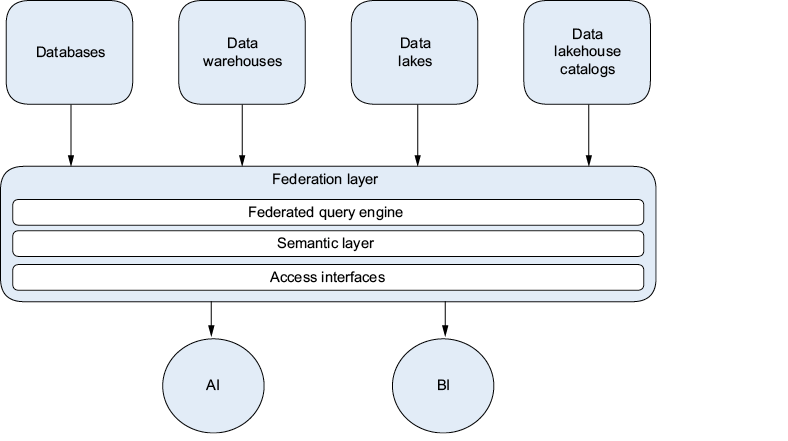
Use the architecture diagram to trace connections from databases, warehouses, lakes, and lakehouse catalogs through the federation layer to AI and BI consumers. section 8.2.1
