Interactive proofs require several messages and participants online together. The Fiat–Shamir transformation replaces the verifier’s challenge with a hash-derived value, making the proof non-interactive. section 7.2.2
The transformation follows a compact recipe:
- Collect the protocol transcript, including the prover’s messages. section 7.2.2
- Hash the transcript to derive a challenge that appears random and is not freely chosen. section 7.2.2
- Include the message being signed in the hash when converting a proof into a signature. section 7.2.2
From Schnorr proof to Dilithium signature
Schnorr replaces the verifier’s challenge with a hash of the transcript and message, producing a signature. Dilithium similarly hashes the message and commitment Ay1 + y2 to obtain its challenge. section 7.2.2 section 14.3.4
Figure 7.7 The left protocol is the Schnorr identification protocol previously discussed, which is an interactive protocol. The right protocol is a Schnorr signature, which is a non-interactive version of the left protocol (where the verifier message is replaced by a call to a hash function on the transcript).
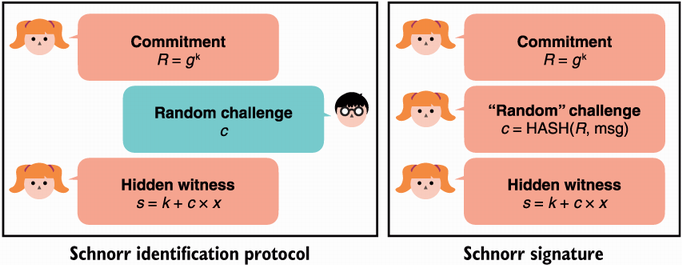
Compare the interactive Schnorr identification protocol with its non-interactive signature form. section 7.2.2
