A non-interactive zero-knowledge proof lets a prover convince a verifier without requiring both parties to exchange messages during the proof operation. It replaces the verifier’s challenge with a hash of the protocol transcript, using the Fiat–Shamir transformation. section 7.2.2 section 7.5
The construction follows a practical chain:
- Hash the exchanged transcript to derive a challenge that appears random but cannot be freely chosen by the prover. section 7.2.2
- Include a message in the hash to bind that message cryptographically to proof of knowledge of the witness. section 7.2.2
- Recognize the resulting Schnorr construction as a digital signature, commonly represented by commitment R and response s. section 7.2.2
Figure 7.7 The left protocol is the Schnorr identification protocol previously discussed, which is an interactive protocol. The right protocol is a Schnorr signature, which is a non-interactive version of the left protocol (where the verifier message is replaced by a call to a hash function on the transcript).
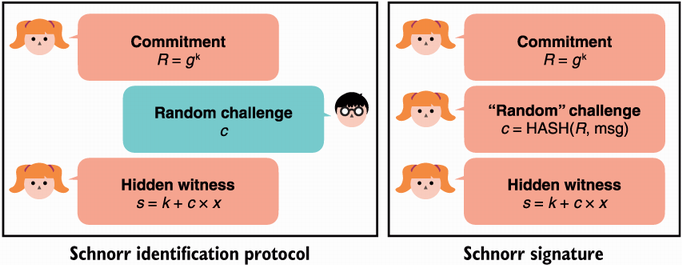
Compare the interactive Schnorr identification protocol with its non-interactive signature form, where hashing replaces the verifier’s message. section 7.2.2
