The Fibonacci sequence provides increasing values for estimating relative effort in story points. A task scored 1 represents the lowest effort, while a task scored 13 represents the highest effort; larger gaps reflect increasing complexity and uncertainty. section 7.2.2
Use the sequence as one option among several estimation approaches:
- Compare tasks by relative effort rather than predicted hours. section 7.2.2
- Choose it alongside or instead of Planning Poker and T-Shirt Sizing, depending on what suits the team. section 7.2.2
- Review and revise estimates as the project develops. section 7.2.2
Search-feature estimates
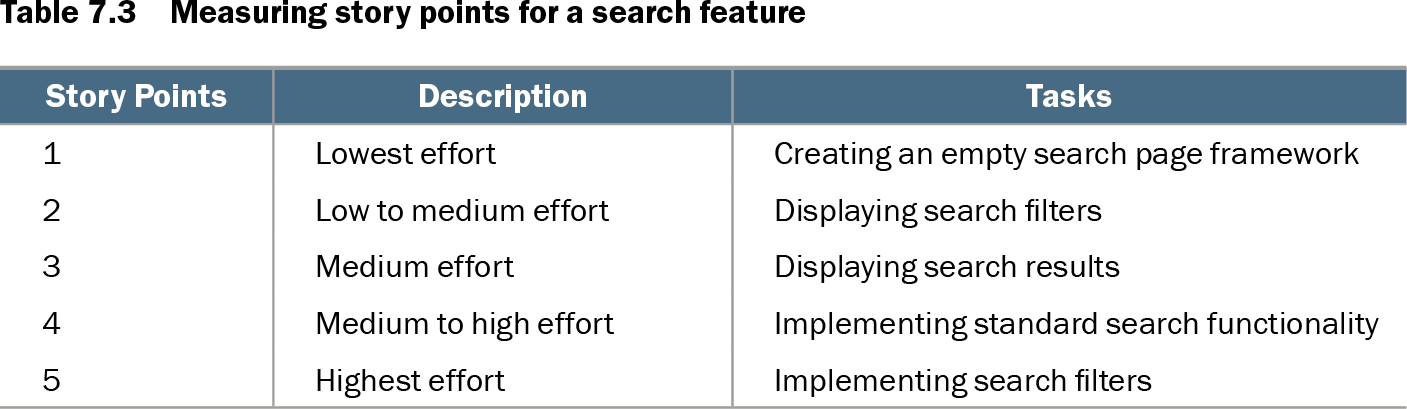
A search feature can be rated from 1 point for creating an empty page framework to 5 points for implementing search filters, with intermediate values for filters, results, and standard search functionality. section 7.2.2
Table 7.3 Measuring story points for a search feature (view table figure)
| Story Points |
Description |
Tasks |
|---|---|---|
| 1 |
Lowest effort |
Creating an empty search page framework |
| 2 |
Low to medium effort |
Displaying search filters |
| 3 |
Medium effort |
Displaying search results |
| 4 |
Medium to high effort |
Implementing standard search functionality |
| 5 |
Highest effort |
Implementing search filters |
Browse the task-by-task table to compare story-point values with concrete search-feature work. section 7.2.2