A Fiedler vector is the eigenvector corresponding to the second-smallest eigenvalue of a graph Laplacian. In spectral clustering, its positive and negative components provide a practical partition of connected data points. section 5.3.1
Use the Fiedler vector within a spectral-clustering workflow:
- Represent data relationships with an adjacency matrix or similarity-weighted affinity matrix. section 5.3.1
- Construct the degree matrix, then calculate the graph Laplacian as L = D − A. section 5.3.1
- Calculate the Laplacian eigenvalues and eigenvectors, and select the vector associated with the second eigenvalue. section 5.3.1
- Separate points according to the vector's positive and negative components to obtain two clusters. section 5.3.2
Partitioning a connected dataset
After forming the adjacency, degree, and Laplacian matrices for connected data points, inspect the Fiedler vector. Its values contain both positive and negative components whose signs divide the points into two distinct clusters. Libraries can perform the matrix and eigenvalue calculations, while the underlying steps clarify how spectral clustering works. section 5.3.2 section 5.3.1
Figure 5.10 The Fielder vector is the output for the Laplacian matrix.
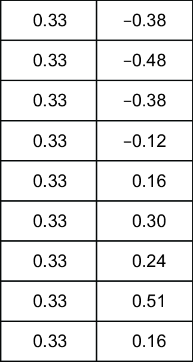
Inspect the Fiedler vector produced from the example Laplacian matrix. section 5.3.2
