A filter expression is a predicate evaluated against an event. An event passes when the predicate is true and fails when it is false; in some cases, the expression cannot be evaluated. section 8.1.1 section 6.2.3
On an input terminal, a filter admits only events that pass. The accepted event-type list is itself a filter; additional expressions can test event attributes. Terminal filtering is stateless: filtering one event does not affect how later events are filtered. section 5.1.3 section 8.1.2
Selecting events
A filter described as “allow only triangle and square events” selects those events and excludes other shapes. A more formal XPath expression, /ranking > 5, tests an event’s ranking against a constant. section 8.1.1
Table 8.1. Features typically found in filter expressions
| Interpretation |
|
|---|---|
| Attribute inclusion | Checks whether the event instance contains an attribute with that name |
| Attribute has value | Checks that the value of the attribute is not null |
| Data type assertion | Checks that the attribute’s value is valid with respect to its data type, for example, that it is valid as a number, string or timestamp |
| Binary relation | Tests the value of an attribute against a constant or against the value of another attribute, using a relation such as <, >, =, ≠, ≤, or ≥ |
| Conjunction | Expression is the conjunction ("AND") of two or more expressions |
| Disjunction | Expression is the disjunction ("OR") of two or more expressions |
| Negation | Expression is the negation of another expression |
Common expression features include attribute checks, comparisons, AND, OR, and negation. section 8.1.1
Keeping a filter on the input terminal separates the selection rule from the consumer or agent’s other behavior. The filter can potentially be performed by a channel or producer. A distribution protocol may also let a consumer supply a filter, allowing a channel to combine consumer filters and filter earlier. section 8.1.1 section 5.3.2
A Filter event processing agent adds a main filtering step after any input-terminal filter. It routes events to Filtered-in when they satisfy the expression, Filtered-out when they do not, and Non-filterable when the expression cannot be evaluated. Unconnected outputs discard their events. Unlike terminal filters, filtering within an agent can be stateful, and events that fail can continue to be processed. section 8.1.2 section 6.2.3
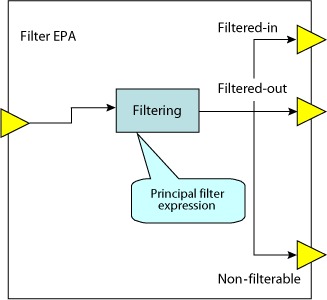
The Filter agent’s three outputs make the distinction between failed and non-filterable events visible. section 6.2.3