An input terminal is a named endpoint through which an event-processing component receives events from other entities. An event processing agent can have multiple input terminals; an event consumer has only input terminals, while a producer has only output terminals. section 2.3.5
In an event processing network, a link connects an output terminal to an input terminal and shows the flow of event instances. Several links can feed one input terminal; their event streams are interleaved, with the interleaving dependent on the implementation. section 6.1.1
Figure 6.1. An example event processing network, showing the graphical notation we are using, and illustrating some of the features of an EPN
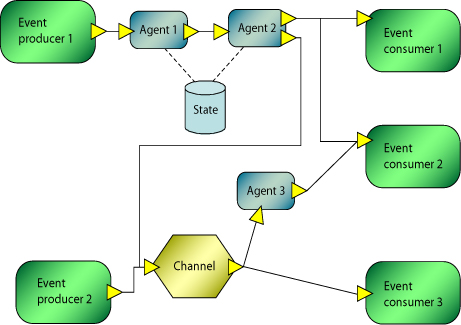
The network diagram shows input terminals as inward-pointing triangles and links carrying events between terminals. section 6.1.1
An event consumer’s input terminal has these attributes:
- Identifier: distinguishes the terminal from other input terminals on the consumer. section 5.1.3
- Event types: lists one or more types the terminal accepts. section 5.1.3
- Filters: optionally restrict accepted event instances further, for example by event attribute values. section 5.1.3
- Sources: identifies zero or more output terminals that can send events to the terminal. Sources can be modeled channels, producers, or agents. section 5.1.3
An abstract consumer type has no sources assigned to its input terminals. Sources can be added when its definition is used as a network node. A source can also identify the input terminal as a target on its own output terminal, without being explicitly listed on the input terminal. section 5.1.3
A filter expression is a predicate evaluated against an event: the event passes if the result is true. Terminal filters make the accepted set visible separately from the agent’s processing logic, and different terminals can have different filters. The filtering itself might be performed by a transmitting channel or by the producer. section 8.1.1
Filtering shapes
If a producer emits events represented by different shapes, an input-terminal filter can allow only triangle and square events through. Other events are filtered out before they pass through the terminal. section 8.1.1
Assigning event types to terminals
In the Fast Flower Delivery model, a consumer that handles several event types could use a separate terminal for each type or one terminal for all types. The model generally uses separate terminals, except when the event types are connected. section 5.4