A finite field is a finite collection of elements where addition, subtraction, multiplication, and division by nonzero elements are defined. In cryptography, prime-modulus arithmetic supplies the setting for Finite Field Diffie-Hellman (FFDH). section 5.2.1
Prime-modulus groups provide the key ingredients:
- Use the strictly positive integers 1 through p − 1 with modular multiplication; every element has an inverse. section 5.2.1
- Add modular addition to the commutative group structure, producing the richer finite-field setting. section 5.2.1
- Work with subgroups when needed; a cyclic subgroup comes from repeatedly multiplying one generator. section 5.2.1
A tiny modular example
Modulo 5, the generator 4 cycles through 4, 1, 4, 1, producing the subgroup {1, 4}. A clock resetting after 4 gives the same wraparound intuition. section 5.2.1
Figure 5.5 The group of integers modulo the prime number 5 can be pictured as a clock that resets to 0 after the number 4. Thus 5 is represented as 0, 6 as 1, 7 as 2, 8 as 3, 9 as 4, 10 as 0, and so on.
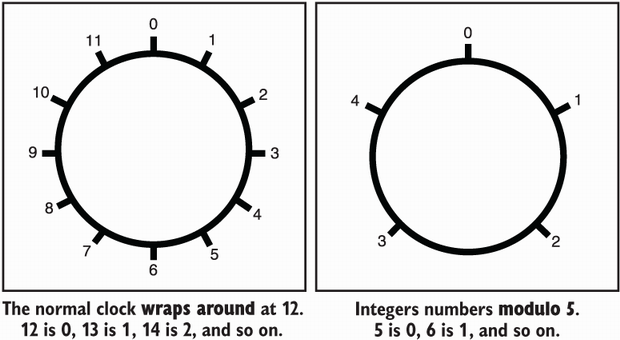
Visualize modular arithmetic as a clock that resets to zero after reaching the prime modulus. section 5.2.1

