liveBook · Manning

Fitting error

As explained in Causal Inference for Data Science

Fitting error is a measure of the discrepancy between a model's predicted outcomes and the observed outcomes used to fit it.

Measures the discrepancy between predicted and observed outcomes. In causal inference, a smaller fitting error does not necessarily identify the model needed to estimate a causal effect. section 6.1.1

Pricing, distance, and customers

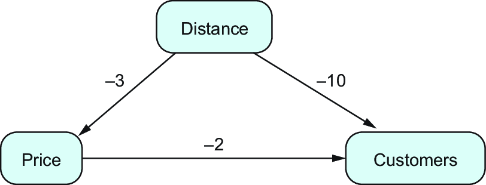
Synthetic Land2Hotel data relate distance, price, and customers. The model customers ~ price + distance can fit better, yet customers ~ distance is the appropriate model for estimating distance’s total effect because price mediates part of that effect. section 6.1.1

Figure 6.1 Graph illustrating the data-generation process for creating synthetic data, as described in the example. The arrows in the graph are labeled with their corresponding linear coefficients, all of which are negative, as this fits the context of the data modeled.
figure

Trace the synthetic data-generating process linking distance, price, and customers before comparing regression models. section 6.1.1

How Causal Inference for Data Science covers it

How deep it goes
Explains the causal-versus-predictive distinction through competing regressions and synthetic data, without developing a general theory of error metrics.
Examples
Uses synthetic Land2Hotel data and regressions of customers on price, distance, or both.
What it assumes
Assumes familiarity with causal inference and linear regression while distinguishing causal effects from prediction.
What you can do after
Evaluate whether a low-error regression answers a predictive question or the intended causal question.
How it connects
Connects fitting error to causal inference, supervised learning, linear regression, mediation, and total effects.

Related concepts

This explainer was generated by Manning's knowledge graph from the text of Causal Inference for Data Science. The section links point to the parts of the book it draws on.