A change can take minutes to code and days to reach a user. Flow is the smooth movement of value from idea to user-visible behavior across the whole development value stream. It is not typing speed, team busyness, or velocity measured in story points. The useful question is: how long does one change take to deliver value, and where does it stop? section 6.0 section 6.1
Trace the actual path: clarify intent, code, review, build and test, deploy, then observe the result. Mark both work and waiting. Pull-request queues, failed builds, blocked environments, and deploy windows can dominate elapsed time even when implementation is quick. A stop-and-restart also costs context and momentum. Flow improves by removing the constraint in that path, not by making an already-fast step faster. section 1.2.5 section 6.1 section 1.2.2
A small fix with a long journey
A session-timeout change takes twenty minutes to make, yet its path to production takes nine days. Across that path, process time is forty minutes while waiting accounts for seven days. The useful investigation is not how to type the fix faster; it is why review availability, deploy scheduling, or queue depth holds it up. Comparing process time with elapsed time makes that mismatch visible. section 6.1
Figure 6.3 A full value stream exposing the length of time a typical small fix takes to flow through the system.
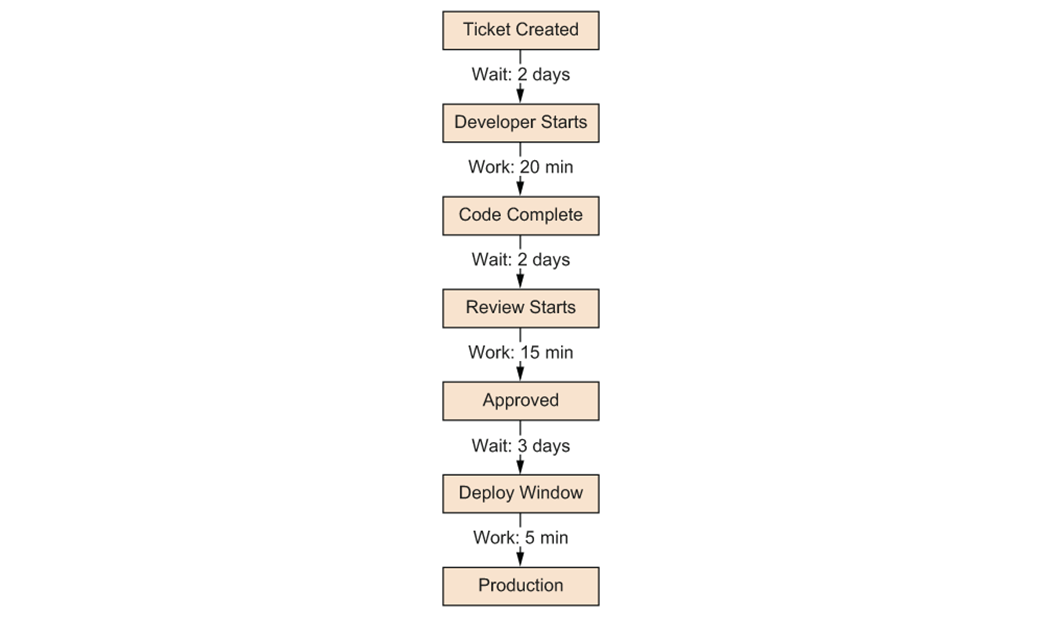
Follow the small fix through its full value stream to see how little of its elapsed time is spent changing the software. section 6.1
When work stalls, use these checks rather than a blanket demand to move faster:
- Count unfinished work: unmerged branches, open PRs, and code awaiting deployment are inventory. Limit work in progress and keep changes small so queues and feedback remain visible. section 6.0 section 6.7
- Look at handoffs. Are requirements clear enough to begin? Are reviews waiting because reviewer capacity is scarce? Is a change ready to deploy only after review and staging validation? section 1.2 section 1.2.5
- Check whether automation shortens feedback or merely moves the queue. A pipeline that grows from 12 to 42 minutes can leave commits waiting, increase context switching, and reduce merge frequency. Preserve necessary validation while reconsidering its sequencing. section 6.5.2
- Follow value beyond deployment. Feature flags, legal approval, billing, or customer readiness may still stand between released code and user benefit. section 6.1.3
Flow is a system property. A team can review one PR before starting new work, for example, and shorten a review queue—but the next constraint may appear in testing or release. AI-generated code can likewise increase output without resolving downstream validation or deferred decisions. Improve the current bottleneck, check whether user value arrives sooner, and inspect the stream again. section 1.2.3 section 3.6 section 6.7
