liveBook · Manning

Fluentd

As explained in Cloud Observability in Action

Fluentd is an open-source data collector that unifies the collection and forwarding of logs and other machine data.

Fluentd is an open-source data collector that unifies log and machine-data collection with forwarding. Its rich plug-in ecosystem supports flexible routing, but its Ruby-and-C implementation has a memory footprint of dozens of megabytes. section 4.1.1

Use Fluentd when:

  • A containerized service needs to send tagged logs through a logging driver to a centralized backend. section 4.1.1
  • A large plug-in ecosystem matters more than the smallest possible agent footprint. section 4.1.1

Containerized log pipeline

A ho11y container tags its output as ho11y and uses the Fluentd logging driver. Fluent Bit receives and routes those records to OpenSearch, where OpenSearch Dashboards supports querying and visualization. section 4.1.1
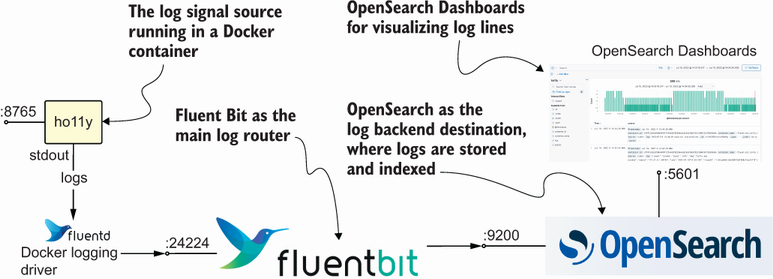
Figure 4.1 Example logging pipeline using Fluentd and Fluent Bit

Trace the signal path from the container and Fluentd logging driver through Fluent Bit to OpenSearch and its dashboard. section 4.1.1


How Cloud Observability in Action covers it

How deep it goes
Defines Fluentd, contrasts its footprint and plug-ins with Fluent Bit, and demonstrates a pipeline without detailing Fluentd configuration internals.
Examples
Uses a ho11y container, tagged records, Fluent Bit routing, and OpenSearch querying in a Docker Compose pipeline.
What it assumes
Assumes familiarity with containers and Docker Compose while deferring detailed OpenSearch treatment.
What you can do after
Operate/configure a containerized log pipeline that forwards tagged application records to a searchable backend.
How it connects
Connects Fluentd with Fluent Bit, Docker Compose, logging drivers, OpenSearch, and OpenSearch Dashboards.

Also explained in

Compare how 4 books explain fluentd →

Related concepts

This explainer was generated by Manning's knowledge graph from the text of Cloud Observability in Action. The section links point to the parts of the book it draws on.

