liveBook · Manning

Fluentd

As explained in Kafka for Architects

Fluentd is an open-source data collector that gathers, transforms, and routes event and log data.

Fluentd is an open-source data collector used to move application log events into centralized processing and storage architectures. section 5.1.3

A Kafka-based logging flow separates application code from transport:

  • Applications emit events through a generic logging framework rather than depending directly on Kafka. section 5.1.3
  • Fluentd agents collect log data from files and forward it to Kafka as log events. section 5.1.3
  • Kafka Connect moves the data from Kafka to Elasticsearch for centralized indexing. section 5.1.3
Figure 5.7 Sending log data via Kafka to Elasticsearch
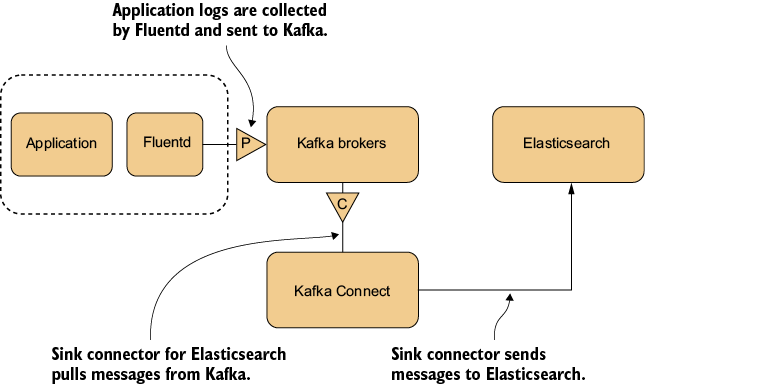
Use the architecture figure to inspect the Fluentd-to-Kafka-to-Elasticsearch log pipeline. section 5.1.3


How Kafka for Architects covers it

How deep it goes
Traces the collection path through Fluentd, Kafka, Kafka Connect, and Elasticsearch without detailing collector internals.
Examples
Uses file-based application logs, Fluentd agents, Kafka topics, Kafka Connect, and Elasticsearch as the concrete pipeline.
What it assumes
Assumes application logging and Kafka concepts while separating logging APIs from transport configuration.
What you can do after
Operate/configure a decoupled log pipeline that forwards application events through Kafka into Elasticsearch.
How it connects
Connects generic logging frameworks with Kafka, Kafka Connect, Elasticsearch, Logstash, Fluent Bit, and syslog.

Also explained in

Compare how 4 books explain fluentd →

Related concepts

This explainer was generated by Manning's knowledge graph from the text of Kafka for Architects. The section links point to the parts of the book it draws on.

