Fluid intelligence is the ability to solve unfamiliar problems by adapting reasoning, abstraction, and learned skills rather than relying only on memorized knowledge. It appears when a system faces a genuinely new situation and must construct a way forward with little or no new data. section 19.2.2
The practical test is novelty: give a learner a brand-new problem instead of repeating familiar questions. Fluid intelligence supports on-the-fly models of situations, anticipation of possible futures, long-term planning, rapid adaptation, and learning new skills after limited practice. section 19.2.2
Fluid intelligence differs from narrower forms of generalization in several ways:
- It recombines knowledge and strategies for situations that were not specified in advance. section 19.3.5 section 19.2.2
- It requires both value-centric abstraction for perception and intuition and program-centric abstraction for exact reasoning, planning, and causal understanding. section 19.5 section 20.3
- It is not demonstrated merely by scale or brute-force search; efficient results matter because intelligence concerns resource use as well as capability. section 19.3.7
ARC-AGI as a practical test
ARC-AGI presents input-output examples that require discovering the underlying transformation. Its resistance to memorization exposes the gap between systems that interpolate familiar patterns and systems that can infer and recombine rules for new tasks. ARC-AGI-2 raises the difficulty with longer reasoning chains and tasks less amenable to exhaustive search. section 19.3.5 section 19.3.7
Figure 19.6 Local generalization vs. extreme generalization
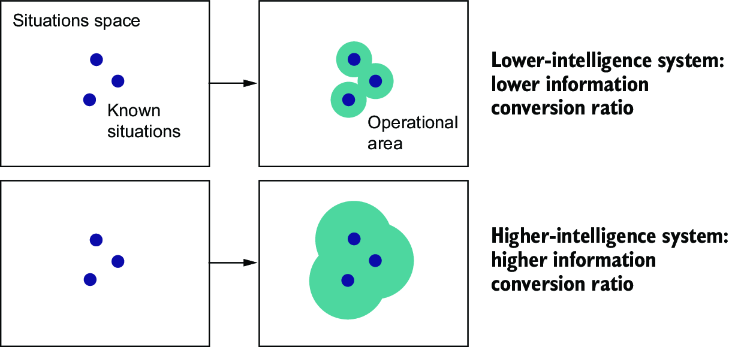
Compare local generalization with extreme generalization to see why modest deviations from training data differ from genuinely novel problem solving. section 19.2.2
Figure 19.10 Example of a task that couldn’t be solved by o3 on the highest compute settings (more than $20,000 per task)
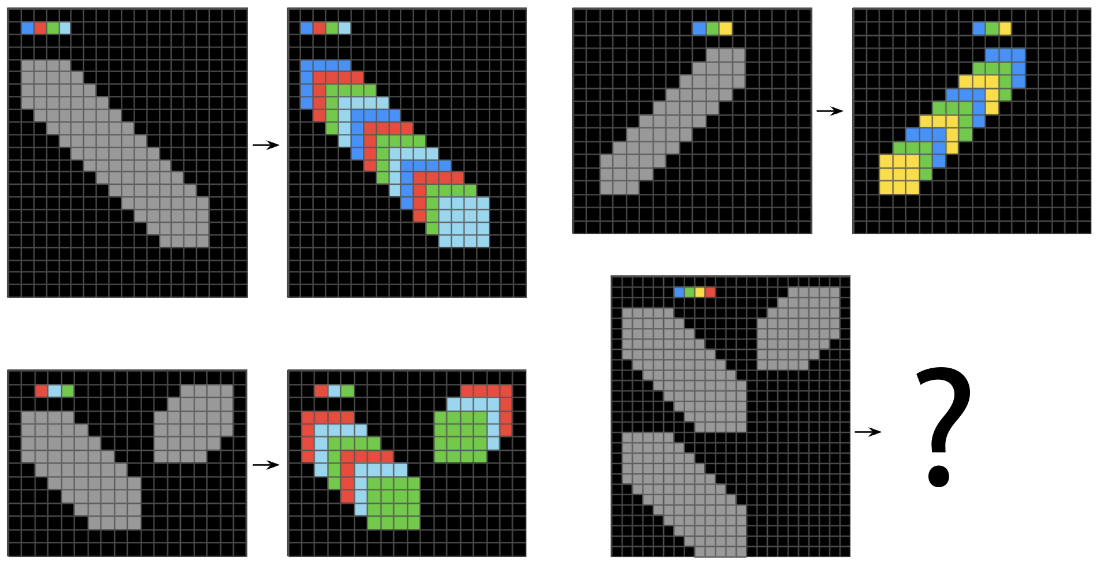
Inspect a task that remained unsolved by o3 even with more than $20,000 of compute, illustrating the limits of brute-force capability. section 19.3.7
