Forecastability is the degree to which a demand series can be predicted accurately from available historical information. In planning, it indicates where a forecasting engine is likely to perform poorly and where review effort may create value. section 13.2.2 section 13.4
Assess forecastability with out-of-sample forecast errors from simple benchmarks, such as moving averages. This tests prediction rather than merely measuring how much demand varied around its historical mean. section 10.2.2 section 10.3
Treat coefficient of variation (COV) cautiously:
- COV divides standard deviation by the mean, but it measures variation around the historical average rather than unexpected future variation. section 10.2
- Trend and seasonality can produce high COV even when moving-average forecasts are accurate. section 10.2.2
- COV can benefit from data leakage because it compares observations with an average that includes information from the same period. section 10.2.1
- Do not replace COV’s problems with after-the-fact deseasonalization or detrending when evaluating forecastability; those transformations can also leak future information. section 10.3
Stable, trending, and seasonal products
For a flat product without trend, seasonality, or another recognizable pattern, COV may roughly indicate forecastability. For products with trend or seasonality, compare a moving-average or seasonal moving-average forecast with actual demand instead. section 10.2.1 section 10.2.2
Figure 10.6 COV vs. moving average for a product with trend
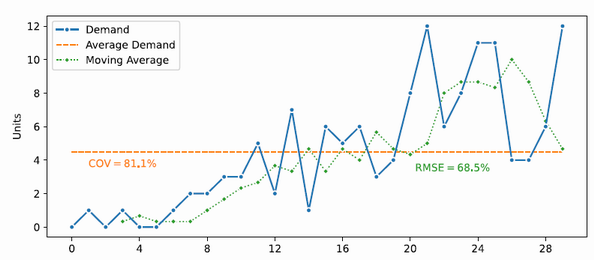
Compare high COV with a moving-average forecast for a product with trend. section 10.2.2
Figure 10.7 COV vs. seasonal moving average for a seasonal product
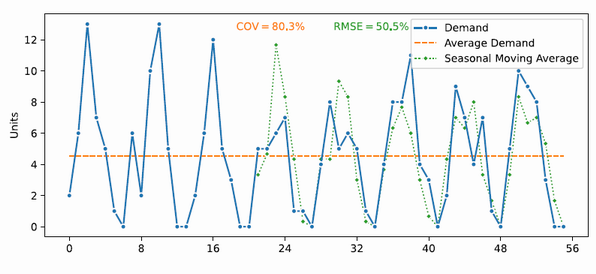
Compare high COV with a seasonal moving-average forecast for a seasonal product. section 10.2.2
