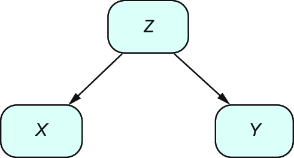
A fork is a three-node causal pattern, X←Z→Y, in which Z is a common cause of X and Y. The shared cause can make X and Y correlated even when neither causes the other. section 7.1.4
Forks matter when separating prediction from causal reasoning. A correlation between X and Y may flow through Z, so estimating an effect requires considering whether conditioning on Z blocks this spurious path. section 7.1.4 section 7.1.6
Synthetic fork data
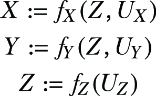
Generate a binary Z, then generate binary X and Y from Z independently. The resulting X and Y can be correlated overall, while conditioning on Z removes the correlation in the fork structure. section 7.1.4
Use the fork pattern to reason about paths:
- Recognize X←Z→Y as a noncausal path between X and Y. section 7.1.4
- Treat Z as a candidate variable for blocking spurious association when estimating the causal effect of X on Y. section 7.1.6
- Do not assume every fork is a confounder: an M-structure can contain a fork without Z directly influencing both target variables. section 7.1.4
Table 7.3 Pure fork DAG
|
DAG
|
Equations
|
|
|
Inspect the pure fork DAG and its equations to connect the three-node diagram with its factorized distribution. section 7.1.4
