The fork/exec model launches a program as a child of the process that requested it. A parent such as Bash forks a child, and that child executes the new program. Podman applies this Unix pattern to containers: Podman starts an OCI runtime, which launches the container as a direct descendant of the container engine. section 1.3.3
This design avoids a permanently running daemon between the user and the container. Docker uses a client, daemon, containerd, and OCI runtime chain; Podman instead lets the user-launched engine create the runtime and container processes directly. Shared filesystem storage and operating-system IPC let multiple engines cooperate without daemon-to-daemon communication, using filesystem locking when coordination is needed. section 1.3.3 section 11.1
Figure 1.9 Podman fork/exec architecture. The user launches Podman, which executes the OCI runtime, which then launches the container. The container is a direct descendant of Podman.
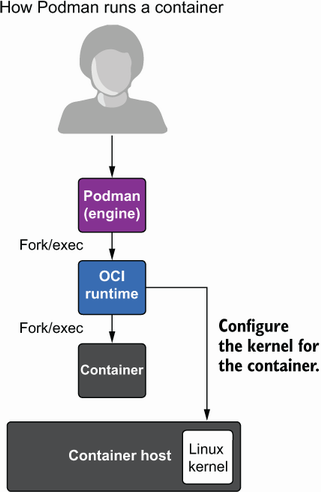
Trace the process ancestry from the user’s Podman command through the OCI runtime to the container. section 1.3.3
The process relationship has practical security and operations consequences:
- Preserves the launching user’s Linux loginuid in the containerized process, allowing audit records to identify which user started the container. section 11.1.2
- Differs from Docker’s daemon path, where containers descend from a system-started daemon and commonly receive loginuid 4294967295 instead of the initiating user’s value. section 11.1.2
- Supports investigation with podman run, podman inspect, /proc/<pid>/loginuid, auditctl, and ausearch rather than treating process ownership as opaque. section 11.1.2
Check container process attribution
Run `podman run -d ubi8-micro sleep 20`, obtain the process ID with `podman inspect -l --format '{{ .State.Pid }}'`, and read `/proc/<pid>/loginuid`. The reported value matches the user’s loginuid, while the comparable Docker process reports 4294967295. section 11.1.2