liveBook · Manning

Forward method

As explained in Rearchitecting LLMs

A forward method is a neural-module method that defines the computation performed when input data passes through the module.

A PyTorch module’s forward method defines its computation and controls execution order. In DistilGPT2, the model-level method passes embeddings through Transformer blocks and applies final normalization. section 3.1 section 3.1.1

Execution proceeds through nested forward calls:

  • GPT2Model iterates through its Transformer blocks. section 3.1.1
  • Each GPT2Block calls its attention module and then its MLP module. section 3.1.1
  • The block-level methods determine internal operations not shown by the module structure or initialization order. section 3.1.1
Figure 3.2 Anatomy of DistilGPT2. On the left, the general architecture is shown: data flows from the Embeddings layer, passes through the stack of six Transformer Blocks, and ends at the output layer. On the right, a "zoom" into one of those blocks reveals a LayerNorm → GPT2Attention → LayerNorm → GPT2MLP flow, where each module processes the information before passing it to the next.
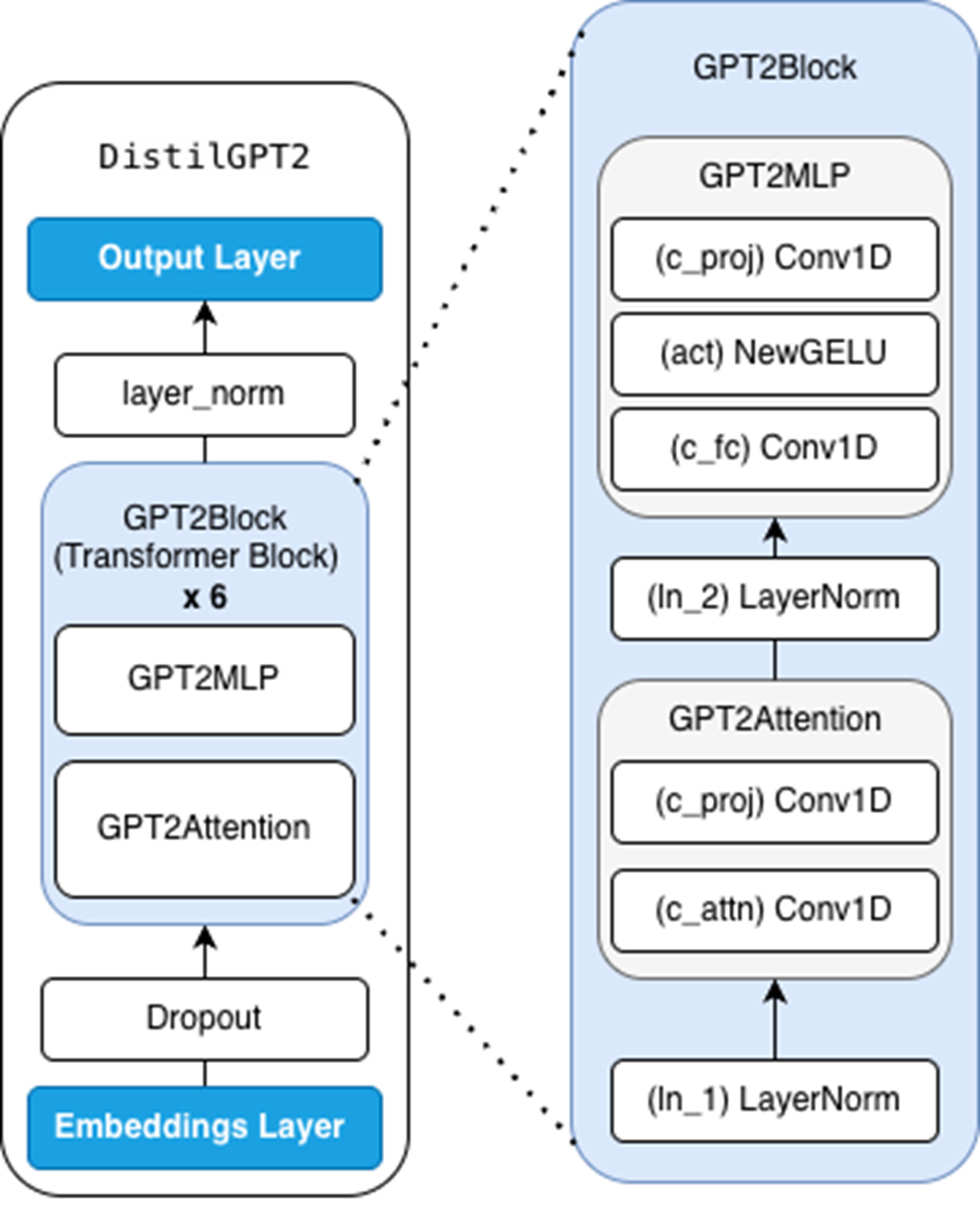
Use the architecture diagram to trace the model’s data flow and zoom into a Transformer block’s module sequence. section 3.1.1


How Rearchitecting LLMs covers it

How deep it goes
Traces nested calls from GPT2Model through blocks to attention and MLP, while deferring their internal operations.
Examples
Traces DistilGPT2 from embeddings through six Transformer blocks to final normalization, with attention and MLP inside each block.
What it assumes
Introduces PyTorch models as Python classes with initialization and forward methods, then explains how their components execute.
What you can do after
Understand how nested forward calls determine a Transformer model’s execution hierarchy and data flow.
How it connects
Connects PyTorch modules with Transformer blocks, attention, MLP, embeddings, and layer normalization.

Also explained in

Compare how 3 books explain forward method →

Related concepts

This explainer was generated by Manning's knowledge graph from the text of Rearchitecting LLMs. The section links point to the parts of the book it draws on.
