A forward pass propagates an input through a neural network to produce a prediction. Each layer transforms the result before passing it onward, like moving through a sequence of decision steps. section 9.4 section 11.32
A basic forward pass through a network follows this sequence:
- Input one example, such as scaled speed, terrain quality, degree of vision, and driving experience. section 9.4
- Multiply each input by the weights connecting it to hidden nodes, then sum the weighted inputs for each node. section 9.4
- Apply an activation function to each hidden-node sum, combine those activated values at the output node, and activate the final sum. section 9.4
- Use the final output as the model’s prediction, such as the estimated chance that a collision will occur. section 9.4
A small neural-network calculation
A pretrained network receives one scaled driving example. It multiplies the four inputs by their connection weights, sums these values for every hidden node, applies sigmoid activation, combines the hidden outputs, and applies sigmoid again to produce the collision prediction. The same pattern can be written as: inputs → weighted hidden layer → activation → weighted output layer → activation. section 9.4 section 9.24
A simple implementation stores input-to-hidden and hidden-to-output weights, computes the hidden activations, and computes the output activations. During training, the forward pass supplies predictions for loss calculation; backpropagation then uses that loss to adjust the weights. section 9.4 section 9.5 section 11.32
Figure 9.14 Life cycle of forward propagation in an ANN
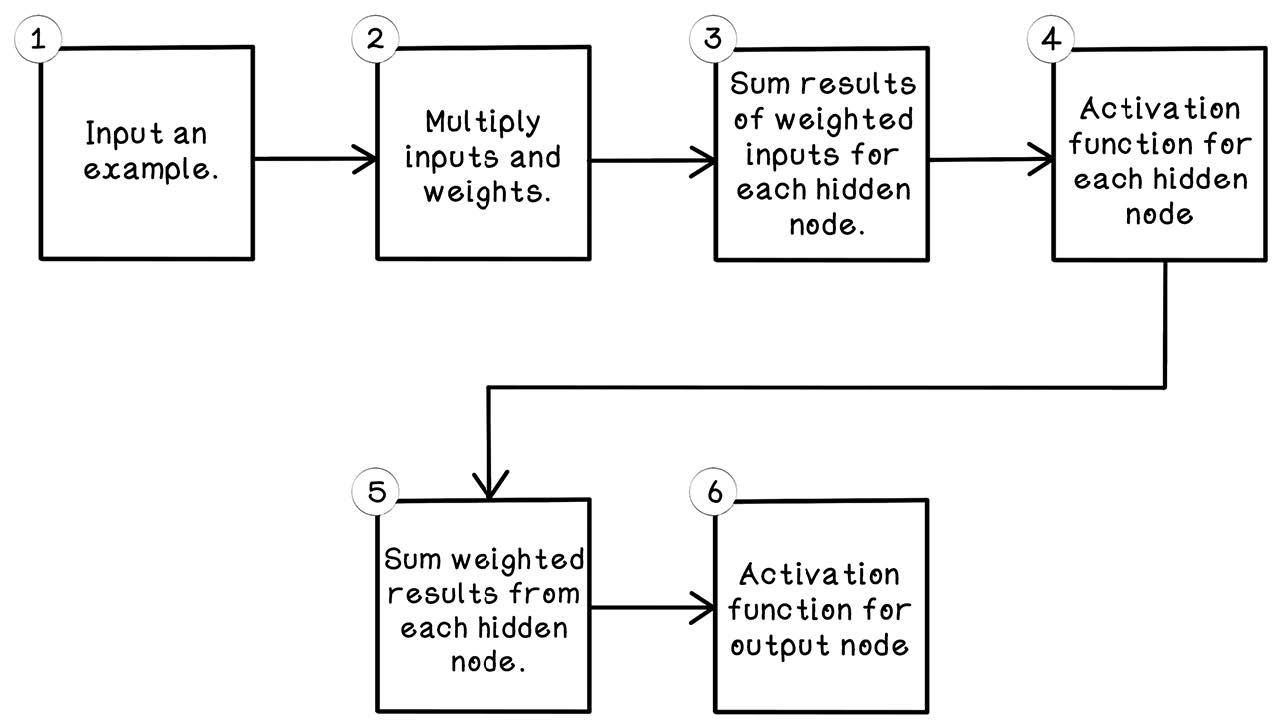
Follow the life cycle from input through weighted sums and activation functions to the final prediction. section 9.4







