A foundational model layer supplies pretrained models that can be reused across drug-discovery tasks. In BioNeMo, these include transformers, graph neural networks, and diffusion models for proteins, small molecules, and genomic data. Trained on large datasets, they encode biological and chemical knowledge as representations that can transfer to downstream tasks. section 13.2.1
The model layer is one part of a modular platform. NVIDIA Inference Microservices (NIM) packages models as containerized services, while blueprints combine models into reference workflows. Researchers can use individual components alongside existing tools rather than adopting an entire workflow. section 13.2.1
Protein embeddings
A team can use ESM-2 to generate protein embeddings—representations of proteins—while keeping its existing small-molecule tools. Alternatively, it can combine BioNeMo’s AlphaFold2 implementation with proprietary docking software. section 13.2.1
Figure 13.1 A virtual screening blueprint that incorporates microservices for protein folding, molecular generation, docking, and molecular simulation (green circles) to speed up development cycles and produce optimized molecules. A user starts by inputting the sequence of the protein target that they want to design against OpenFold2, which leverages additional databases and computational tools, such as MMseq2 to align the target protein sequence to other known proteins, to determine the target protein’s structure. The user also provides an initial library of chemical fragments to GenMol to seed its generative chemical design. For any given microservice, the user has multiple configuration settings to choose from and, in the case of molecular generation, they could define the oracles that dictate what properties to optimize for (e.g., quantitative estimate of drug-likeness, solubility, human feedback), the number of molecules to generate, and other constraints. The generated molecules are scored and passed back to GenMol for further optimization for multiple cycles depending on the number of iterations the user selects. These molecular structures and the structure of the protein target are passed to the DiffDock NIM, which generates the number of binding poses that the user indicates, along with other constraints. These poses can be further validated and refined using molecular simulation tools or other high-fidelity, computational oracles before being passed to the user for determination of next steps, such as wet-lab experimentation.
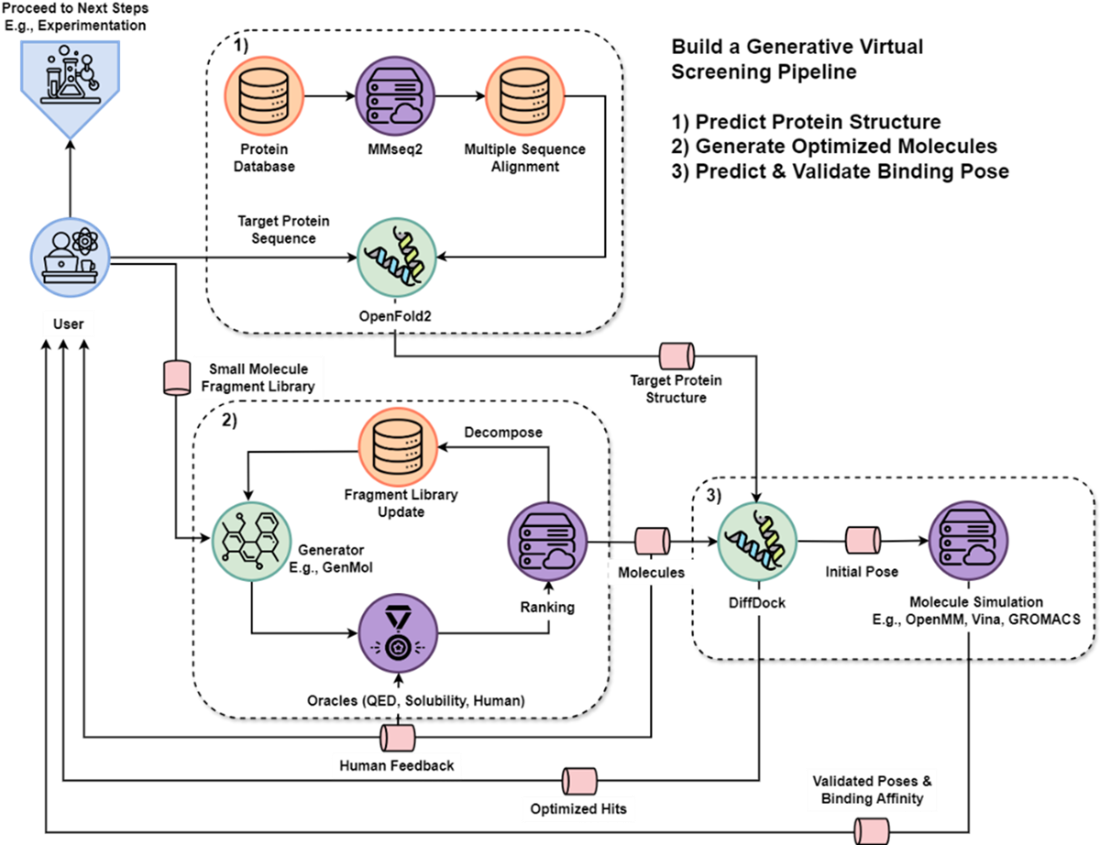
Follow a virtual screening blueprint from protein structure prediction and molecular generation through docking and simulation. section 13.2.1
