BioNeMo is NVIDIA’s platform for developing and deploying AI models for biology and drug discovery. Its components can be used individually or combined into workflows spanning target identification and lead optimization. It is one way to assemble such workflows, not the only one: many of its models are also available through open toolchains. section 13.2 section 13.5
The platform has three architectural layers:
- Foundation models provide pretrained models for proteins, small molecules, and genomic data. Their learned representations can support downstream tasks. section 13.2.1
- NVIDIA Inference Microservices (NIM) package models as containerized services with optimized inference engines for deployment. section 13.2.1
- Blueprints document customizable workflows that combine models and services for drug discovery problems. section 13.2.1
A team can use ESM-2 alone to generate protein embeddings—numerical representations of protein sequences—or combine a BioNeMo structure-prediction model with its own docking software. For larger workloads, the microservices architecture supports scaling across GPU clusters. section 13.2.1
Figure 13.1 A virtual screening blueprint that incorporates microservices for protein folding, molecular generation, docking, and molecular simulation (green circles) to speed up development cycles and produce optimized molecules. A user starts by inputting the sequence of the protein target that they want to design against OpenFold2, which leverages additional databases and computational tools, such as MMseq2 to align the target protein sequence to other known proteins, to determine the target protein’s structure. The user also provides an initial library of chemical fragments to GenMol to seed its generative chemical design. For any given microservice, the user has multiple configuration settings to choose from and, in the case of molecular generation, they could define the oracles that dictate what properties to optimize for (e.g., quantitative estimate of drug-likeness, solubility, human feedback), the number of molecules to generate, and other constraints. The generated molecules are scored and passed back to GenMol for further optimization for multiple cycles depending on the number of iterations the user selects. These molecular structures and the structure of the protein target are passed to the DiffDock NIM, which generates the number of binding poses that the user indicates, along with other constraints. These poses can be further validated and refined using molecular simulation tools or other high-fidelity, computational oracles before being passed to the user for determination of next steps, such as wet-lab experimentation.
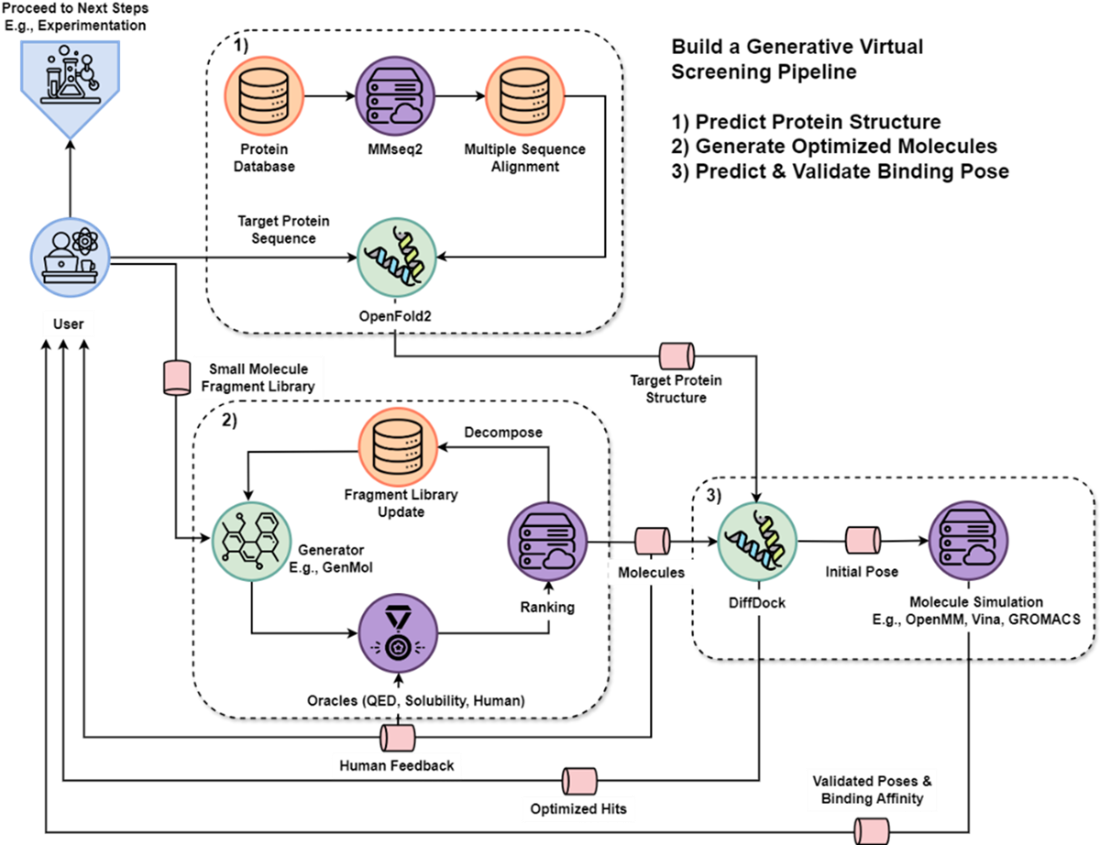
This virtual screening blueprint connects protein structure prediction, molecule generation, docking, and simulation; generated candidates can be refined over multiple cycles. section 13.2.1
Screening for FADS1 inhibitors
A Receptor.AI campaign used BioNeMo components to screen approximately 4.3 billion small molecules against FADS1, a potential target for metabolic disease. Its funnel applied fast filters first, then more expensive docking and ADMET profiling to smaller sets. ESM-2 and ESMFold helped produce a protein structure when no high-resolution experimental structure was available. section 13.3.2
Performance claims need context. NVIDIA reports training a 3-billion-parameter ESM-2 model in about 4.2 days, versus about 30 days for a standard PyTorch baseline on one benchmark. The result is vendor-reported and hardware-dependent, not a guarantee. Computational predictions also need experimental validation and human oversight. section 13.2.1 section 13.5
