Fraud is deliberate deception: a bad actor misleads a good actor to gain money or another unjust benefit, often by exploiting the trust attached to an authentic entity. Online forms include fraudulent payments, phishing, fake social-network accounts, and forged documents. Detection decides whether an interaction or transaction is fraudulent. section 1.1 section 1.7
Parcel-delivery phishing
A convincing-looking delivery email can direct a recipient to a fake Royal Mail page that requests personal details and a one-time password. The attacker impersonates a trusted service, collects credentials, and can use them to pursue financial theft. Checking the destination link and inspecting page behavior expose signals that the message is not genuine. section 1.1
Classify fraud through three lenses: the industry where it occurs, the attack’s modus operandi, and the data modality available. These choices shape both the data and deployment constraints. Payment fraud, for example, uses transaction attributes and needs very low latency and high throughput at the payment interface. section 1.5 section 1.7
Detection approaches progress with fraud volume and complexity:
- Use fixed expert, data-curated, or regulatory rules for limited-scale or exceptional scenarios. section 1.7
- Use machine learning for scalable, efficient, maintainable detection, while retaining rules for extreme cases and regulatory obligations. section 1.7
- Use deep learning for unstructured images, text, or speech when sufficient data and compute are available; document forgery calls for computer vision over manipulated image pixels. section 1.5.4 section 1.7
Figure 1.14 Three ways of categorizing online fraud: the industry or sector in which fraud is perpetrated, the nature of the fraudulent attack, and the modalities of data involved.
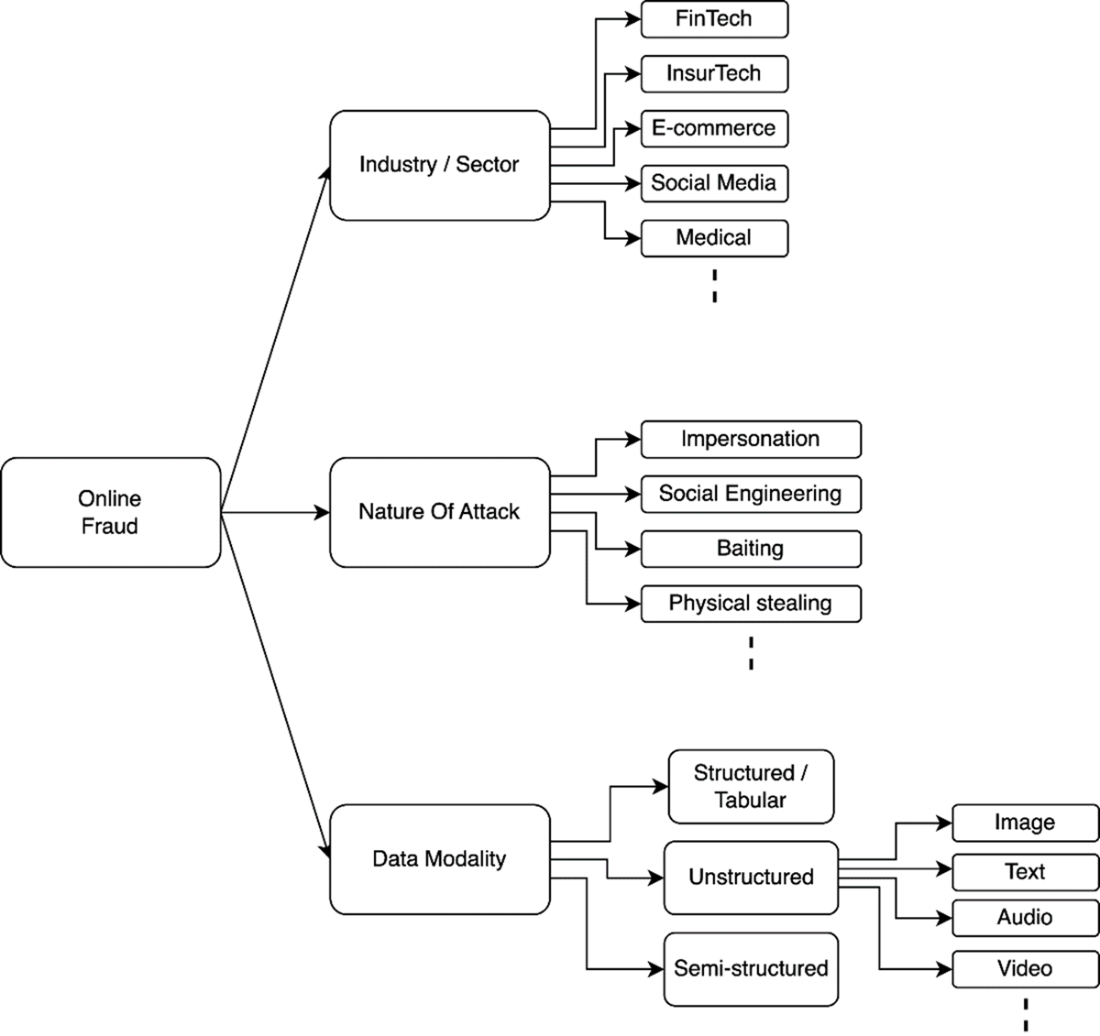
Compare the three classification lenses before selecting data, model family, and deployment priorities for a fraud problem. section 1.5
A basic operational workflow is to analyze a phishing dataset, curate rules, evaluate their performance, and package the result as an executable Python detector. The same progression provides a starting point for other fraud problems before moving to more advanced models. section 2.0


