liveBook · Manning

Freeze

As explained in Deep Learning with Python, Third Edition

To keep selected model parameters unchanged during training so they do not receive optimizer updates.

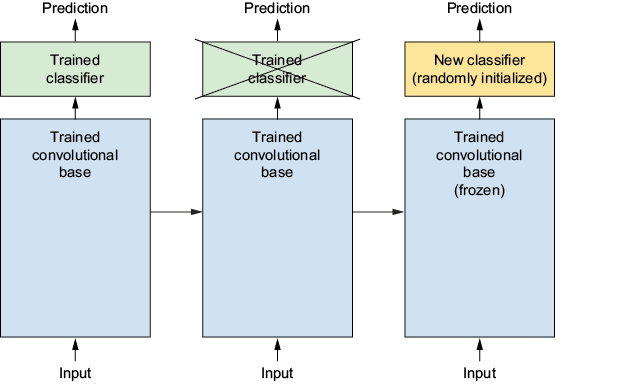
Freezing keeps selected model weights unchanged during training. In transfer learning, freeze a pretrained convolutional base while a newly added classifier learns, protecting previously learned representations from destructive updates. section 8.3.1

Freeze a pretrained base

In Keras, set `conv_base.trainable = False`, connect the base to a new dense classifier, and compile the model. Only the classifier’s weights are then trained. Recompile whenever trainability changes, or the optimizer may ignore the change. section 8.3.1

Use freezing as part of a staged transfer-learning workflow:

  • Add the custom network, freeze the base, and train the added classifier before changing the base. section 8.3.2
  • When fine-tuning, unfreeze all or selected upper layers; keep lower layers frozen because they encode more generic features. section 8.3.2
  • Do not unfreeze BatchNormalization layers during this procedure. section 8.3.2
Figure 8.12 Swapping classifiers while keeping the same convolutional base
swapping fc classifier

Visualizes swapping a classifier while retaining the same convolutional base. section 8.3.1

How Deep Learning with Python, Third Edition covers it

How deep it goes
Defines weight immutability, shows Keras configuration and recompilation, and gives staged and partial fine-tuning procedures.
Examples
Uses a frozen Xception convolutional base, dense classifier, augmented image dataset, trainable-weight counts, and staged fine-tuning.
What it assumes
Assumes a pretrained base and added classifier, while teaching why classifier training precedes unfreezing.
What you can do after
Operate/configure Keras models by freezing bases, training replacement classifiers, recompiling, and selectively unfreezing layers.
How it connects
Connects freezing with transfer learning, feature extraction, fine-tuning, data augmentation, pretrained models, and batch normalization.

Also explained in

Compare how 2 books explain freeze →

Related concepts

This explainer was generated by Manning's knowledge graph from the text of Deep Learning with Python, Third Edition. The section links point to the parts of the book it draws on.
