The frequentist paradigm interprets probability as the long-run frequency of an event across infinitely many repeatable trials. An unknown quantity is treated as fixed; randomness enters through the process that generates observed data. section 1.6
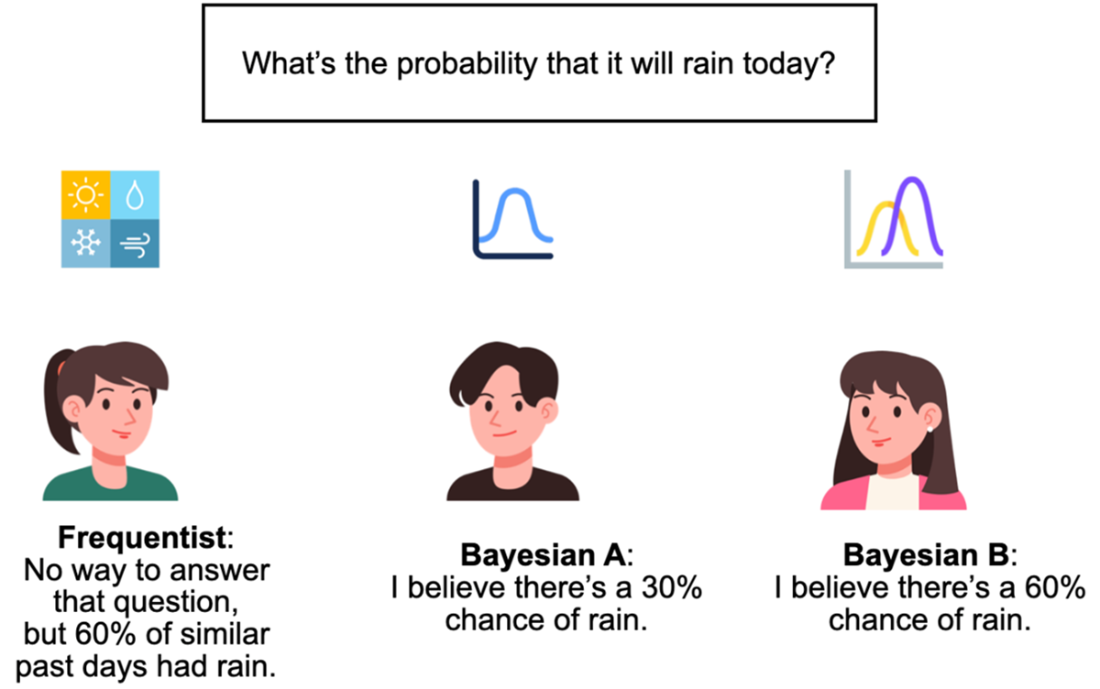
This viewpoint makes probability questions depend on repeatability. A frequentist may reject “What is the probability it rains today?” because today cannot be repeated, and instead calculate how often comparable observations produce rain. Frequentist methods are computationally lightweight, ready to use, and require fewer diagnostics than Bayesian models. section 1.6
The paradigm is commonly associated with:
- Fixed unknown quantities whose observed data vary through chance. section 1.6
- Established procedures such as classical hypothesis testing and p-values. section 11.1 section 1.6
- Large-dataset applications that do not require constructing a prior distribution. section 1.6
Weather as a boundary case
A Bayesian analysis can assign a probability of rain using humidity and cloud cover as evidence. A frequentist analysis instead asks about rain frequencies across repeatable observations or trials. section 1.6
Compare situations favoring frequentist methods, including abundant data, no required prior knowledge, and established objectives such as A/B testing. section 1.6