An FTP data connection is the separate TCP connection that carries file data. The control connection on TCP port 21 authenticates the client and carries commands, while the data connection performs the actual file exchange. section 8.2.1 section 8.4
Remember these implementation and exam points:
- Establishes a second TCP handshake for each data transfer; one control connection can support multiple simultaneous data connections. section 8.2.1
- Associates TCP port 20 with FTP data connections for CCNA memorization, although modern servers often advertise an ephemeral port through the control connection. section 8.2.1 section 8.4
- Uses active mode when the server initiates the data connection and passive mode when the client initiates it; passive mode avoids many firewall and NAT problems. section 8.2.1
Downloading a file
When SW1 retrieves a file, it authenticates and sends the RETR command over the control connection. The server and client then establish the separate data connection, through which the server transfers the file. section 8.2.1
Figure 8.4 An FTP exchange involves two TCP connections: an FTP control connection, and an FTP data connection.
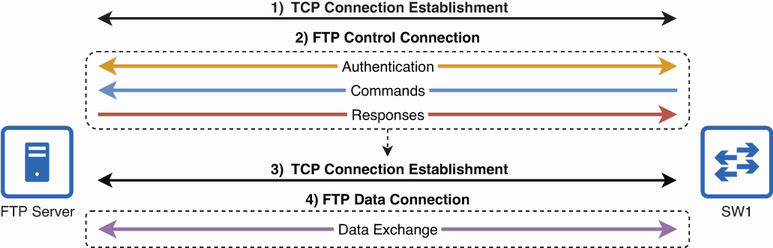
Trace the FTP exchange as two TCP connections: one for control traffic and one for transferred data. section 8.2.1
