liveBook · Manning

Full mesh topology

As explained in Acing the CCNA Exam: Volume 2 Advanced Networking and Security

A full mesh topology is a network arrangement in which every device has a direct connection to every other device.

A full mesh topology directly connects every device to every other device. This arrangement provides multiple paths to each destination, improving reliability when a link fails. section 15.1

Counting full-mesh links

Calculate the number of links with N(N−1)/2. Six routers therefore require 15 links. In a campus LAN, distribution switches may form a full mesh while access switches form a partial mesh. section 15.1 section 15.2.1

Figure 15.1 Common topologies. In a star topology, all devices connect to a central device. In a full mesh, each device is directly connected to each of the other devices. In a partial mesh, only certain devices are directly connected.
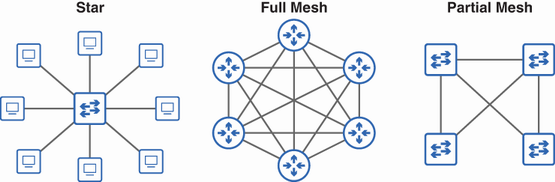
Compare full mesh with star and partial mesh by tracing which devices have direct connections. section 15.1

How Acing the CCNA Exam: Volume 2 Advanced Networking and Security covers it

How deep it goes
Defines direct connectivity, reliability benefits, and link counting, but stops short of configuration and troubleshooting procedures.
Examples
Uses six routers with 15 links and distribution-switch connections in a two-tier campus LAN.
What it assumes
Assumes basic understanding of devices, links, and network topologies while defining full, partial, star, and hybrid arrangements.
What you can do after
Evaluate network diagrams, identify full-mesh links, and calculate required connections from the device count.
How it connects
Contrasts with star topology, partial mesh, hybrid topology, and hierarchical campus LAN design.

Related concepts

This explainer was generated by Manning's knowledge graph from the text of Acing the CCNA Exam: Volume 2 Advanced Networking and Security. The section links point to the parts of the book it draws on.