A leased line is a dedicated physical connection between two sites with fixed bandwidth reserved for that connection. Enterprises use leased lines to connect LANs across a WAN, commonly through a service provider network. section 16.1 section 16.1.1
Figure 16.1 An enterprise WAN connecting four offices and a data center via a service provider’s network infrastructure
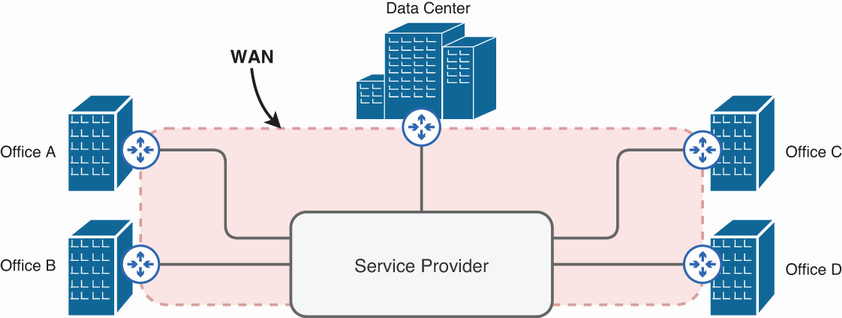
Use the WAN diagram to place leased lines in an enterprise topology connecting office LANs and a data center through a service provider network. section 16.1
Key operational characteristics include:
- Provides consistent bandwidth because the connection is not shared with other customers. section 16.1.1
- Improves privacy because the connection is physically dedicated. section 16.1.1
- Costs more and generally provides less bandwidth than modern alternatives. section 16.1.1
- Traditionally uses serial connections rather than Ethernet; fiber-optic Ethernet may also be offered as a broader modern usage. section 16.1.1 section 16.4
Hub-and-spoke WAN
Four office sites can connect directly to one central data center using four leased lines. A full mesh between the five sites would require ten lines, making it much more expensive. section 16.1.1
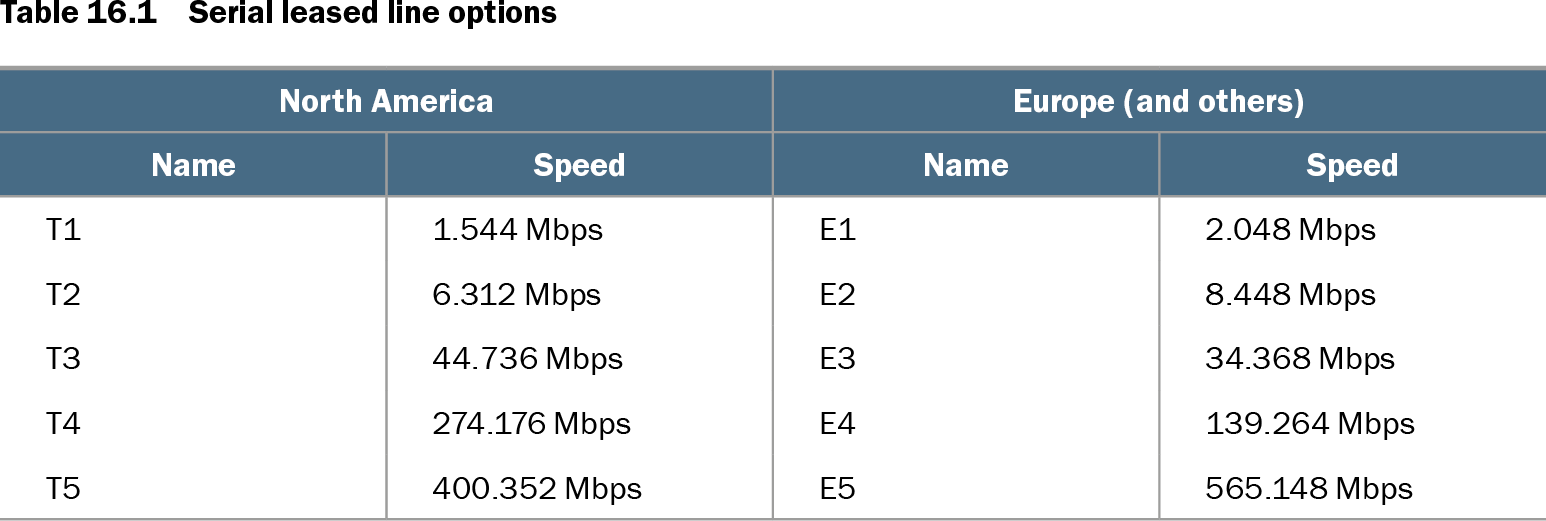
Table 16.1 Serial leased line options (view table figure)
| North America |
Europe (and others) |
||
|---|---|---|---|
| Name |
Speed |
Name |
Speed |
| T1 |
1.544 Mbps |
E1 |
2.048 Mbps |
| T2 |
6.312 Mbps |
E2 |
8.448 Mbps |
| T3 |
44.736 Mbps |
E3 |
34.368 Mbps |
| T4 |
274.176 Mbps |
E4 |
139.264 Mbps |
| T5 |
400.352 Mbps |
E5 |
565.148 Mbps |
Compare serial leased-line options, including T1 through T5 in North America and E1 through E5 in Europe and other regions. section 16.1.1