A wide area network (WAN) connects geographically dispersed local area networks (LANs), often across cities or countries. Enterprises use WANs to let users at offices, stores, and data centers share applications, files, inventory systems, monitoring, and analytics. section 16.0 section 16.1
Figure 16.1 An enterprise WAN connecting four offices and a data center via a service provider’s network infrastructure
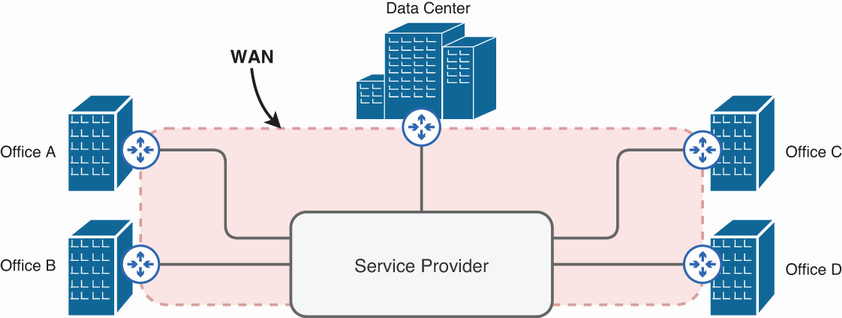
Use the topology figure to visualize four offices and a data center connected through a service provider network. section 16.1
Key WAN technologies and operating roles include:
- Leased lines provide dedicated physical connections with reserved bandwidth. They are private and secure, but typically cost more and provide less bandwidth than modern alternatives; traditional deployments use serial connections, although fiber-optic Ethernet is also available. section 16.4
- Multiprotocol Label Switching (MPLS) forwards packets using an added label between the Layer 2 and Layer 3 headers rather than routing only by IP address. section 16.4
- MPLS commonly uses customer edge (CE), provider edge (PE), and provider (P) routers: CE connects the customer, PE assigns or removes labels, and P forwards labeled packets inside the provider network. section 16.4
- MPLS uses shared provider infrastructure while labels segregate customer traffic through VPNs; L2VPN makes the provider network transparent to CE routers. section 16.4
Enterprise WAN
A multinational corporation can connect its New York headquarters, Chinese manufacturing facilities, European regional offices, and data center LANs so users communicate and share centralized resources. section 16.0
