A star topology arranges a network around one central device: every peripheral device connects to that center rather than directly to the others. The common LAN example is a group of end hosts connected to a switch. In WAN contexts, the same hub-and-spoke pattern is more commonly named hub-and-spoke topology. section 15.1
Figure 15.1 Common topologies. In a star topology, all devices connect to a central device. In a full mesh, each device is directly connected to each of the other devices. In a partial mesh, only certain devices are directly connected.
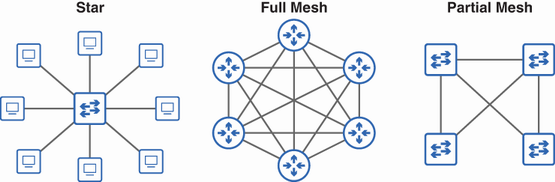
Compare the central-device structure of a star with the direct links of full-mesh and partial-mesh topologies. section 15.1
Use these distinctions when identifying topology architectures:
- Identify the central device as the hub and connected peripheral devices as the spokes. section 15.1
- Contrast a star with a full mesh, where every device connects directly to every other device. section 15.1
- Recognize a partial mesh when only selected devices have direct connections, such as switches across campus layers. section 15.1
- Expect real networks to combine star, mesh, and other patterns as hybrid topologies. section 15.1
