User profile
A user profile is a collection of information associated with a user or account, such as identifying attributes, preferences, settings, or activity.

Django in Action
A user profile is a model object that stores additional data associated with a user account and related domain objects.
- How it is used
- Associates Django user accounts with application domain data used by administration and view authorization.
- How deep it goes
- Defines the model and admin wiring, then implements automatic creation and authorization checks without detailing custom User internals.
- Examples
- Demonstrates RiffMates UserProfile links to Musician and Venue, an admin inline, and a bandmate-restricted view.
- What you can do after
- Build it from scratch as a Django model, administer it inline, and create it automatically after User creation.
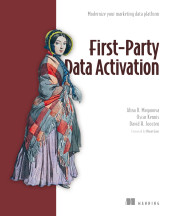
First-Party Data Activation
A consolidated representation of a customer’s identifying details, characteristics, interactions, and preferences.
- How it is used
- Uses unified profiles to connect fragmented customer data with targeting, personalization, and marketing activation.
- How deep it goes
- Explains profile unification and architecture trade-offs, including identity-matching transparency, synchronization, and reliability.
- Examples
- Illustrates false-positive identity matching at a university and profile synchronization through a travel company's data warehouse.
- What you can do after
- Evaluate profile solutions for matching transparency, a shared source of truth, and risks from separate copies.
Read how First-Party Data Activation explains user profile →

AI-Powered Search
A user profile is a representation of an individual user's attributes, preferences, or characteristics.
- How it is used
- Uses profiles alongside queries to personalize search and as explicit inputs to recommendations.
- How deep it goes
- Explains profile inputs and content-embedding approaches, while deferring the mechanics of language-model training.
- Examples
- Illustrates profiles with restaurant location, job preferences, product affinities, and embeddings generated from product names.
- What you can do after
- Evaluate how user signals and content embeddings can inform personalized results while considering cold start, privacy, and over-personalization.
Also covered in
- Python How-To
- Practical Automation with PowerShell: Effective scripting from the console to the cloud
What to know first
- clusteringClustering is the process of grouping data items so that items within a group are more similar to one another than to items in other groups.
- language modelA language model is a computational model that represents patterns in linguistic sequences to assign probabilities, predict, generate, or evaluate language.
- personalizationPersonalization is the adaptation of content, recommendations, decisions, or system behavior to an individual’s characteristics, preferences, history, or context.
Related concepts
- custom user modelalternative to · A custom user model is an application-defined model that replaces Django's built-in user model and can define different account data and credential behavior.
- entity resolutionhas part · Entity resolution is the process of determining which records or mentions refer to the same real-world entity despite differences in their representations.
- preferencehas part · A preference is a comparative judgment or inclination that favors one alternative, outcome, or characteristic over others.
- personalizationused by · Personalization is the adaptation of content, recommendations, decisions, or system behavior to an individual’s characteristics, preferences, history, or context.
- user-guided recommendationused by · A user-guided recommendation combines recommendation signals with explicit keyword or query input to constrain suggested results.
- embeddingproduced by · An embedding is a numerical vector representation of an item in a feature space, encoding selected properties or relationships for computational tasks such as comparison or retrieval.
Questions about user profile
What is user profile?
A user profile is a collection of information associated with a user or account, such as identifying attributes, preferences, settings, or activity.
Which Manning books explain user profile?
Django in Action, First-Party Data Activation and AI-Powered Search.
What should I know before learning user profile?
Manning books that teach user profile usually introduce clustering, email address, language model and personalization first.
What is the difference between user profile and custom user model?
A user profile is a collection of information associated with a user or account, such as identifying attributes, preferences, settings, or activity. A custom user model is an application-defined model that replaces Django's built-in user model and can define different account data and credential behavior.
What are the parts of user profile?
User profile includes entity resolution and preference.
These guides are generated from the text of Manning books by Manning's knowledge graph and link to the sections they draw on. The full books are available on liveBook and at manning.com.