User-guided recommendation combines recommendation signals with explicit user control. The system uses a profile—such as interaction history or inferred preferences—while allowing the user to inspect or adjust those inputs. section 1.2.3 section 9.1.2
A typical flow connects search and recommendation capabilities:
- Start with explicit keyword or query input, then combine it with user-specific preferences to constrain or personalize results. section 1.2.3 section 1.2.5
- Expose profile inputs that users can review and override, including viewed, clicked, or purchased items and inferred attributes. section 9.1.2
- Treat the technique as a middle point between personalized search and recommendations without user control. section 1.2.3
Editable recommendation preferences
A recommendation interface might let someone mark favorite movies, restaurants, or places, while also editing inferred preferences such as clothing sizes, brand affinities, colors, local stores, job titles, skills, or salary ranges. section 9.1.2
Figure 1.5 The personalization spectrum, showing traditional keyword search and traditional recommendations as two ends of a larger continuum
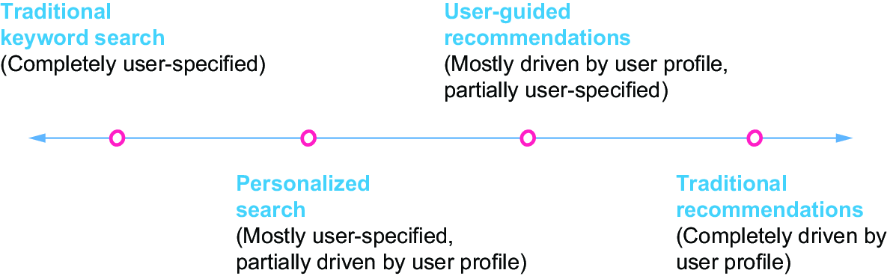
Use the personalization spectrum to compare traditional keyword search, personalized search, user-guided recommendations, and traditional recommendations. section 1.2.3
