A fully specified static route identifies both the next-hop IP address and the exit interface. This tells the router where to send the packet and which interface to use. section 9.3.1
Configure an IPv4 route with the destination network, mask, exit interface, and next hop: ip route 192.168.3.0 255.255.255.0 g0/0 192.168.12.2. The router can forward traffic without a recursive lookup or proxy ARP. section 9.3.1
IPv4 routing-table confirmation
R1# show ip route S 192.168.3.0/24 [1/0] via 192.168.12.2, GigabitEthernet0/0 The entry shows both required values: 192.168.12.2 is the next hop, and GigabitEthernet0/0 is the exit interface. section 9.3.1
Distinguish route types by the forwarding information they specify:
- Recursive static routes specify only a next-hop IP address and require multiple routing-table lookups. section 9.4
- Directly connected static routes specify only an exit interface, may rely on proxy ARP, and should generally be avoided in real networks. section 9.3.1
- Fully specified static routes specify both values; recursive and fully specified routes have no noticeable performance difference in practice. section 9.3.1
IPv6 uses the same principle with ipv6 route. For example: ipv6 route 2001:db8:1::/64 g0/0 2001:db8:23::1. The routing table displays both the next hop and interface. section 21.3.1
Figure 21.10 Configuring fully specified static routes on R1, R2, and R3 to enable PC1–PC3 communication. Each route’s exit interface and next-hop IP address are specified.
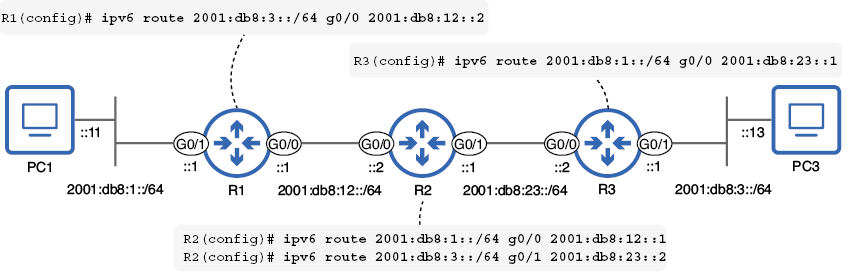
Use the topology to trace fully specified IPv6 routes between R1, R2, and R3, including each route’s exit interface and next-hop address. section 21.3.1
For CCNA questions, classify the destination separately from next-hop specification: a network or host route describes the destination, while recursive, directly connected, or fully specified describes forwarding information. section 9.3.2
