Fuzzy clustering groups observations when cluster boundaries overlap. Instead of assigning each observation to exactly one cluster, it gives the observation a membership degree for multiple clusters; points nearer a center receive stronger membership. section 5.5 section 5.5.1
Hard clustering, such as k-means, makes exclusive assignments. Fuzzy clustering represents intermediate locations between clusters, using least squares to seek an optimal placement. Membership values lie between 0 and 1, but their sum need not equal 1. section 5.5 section 5.5.1
Common fuzzy-clustering families include:
- Fuzzy c-means (FCM) is the most popular algorithm and resembles k-means while assigning membership grades. section 5.5.1
- Gustafson–Kessel associates observations with clusters and covariance matrices, producing elliptical clusters that can adapt to varied structures. section 5.5.1
- Gath–Geva fuzzifies statistical estimators and can produce clusters of any shape rather than optimizing an objective function. section 5.5.1
- Shape-based methods impose forms such as circular clusters. section 5.5.1
Interpreting membership
For customer-transaction data grouped into two clusters, a point close to a cluster centroid receives a higher membership degree than a point near the boundary. A boundary point may belong to both clusters rather than receiving one forced label. section 5.5.1
Figure 5.15 The figure on the left represents all the data points. The red points (those with an x in the print version) can belong to more than one cluster. In fact, we can allocate more than one cluster to each point. A probability score can be given for a point to belong to a particular cluster.
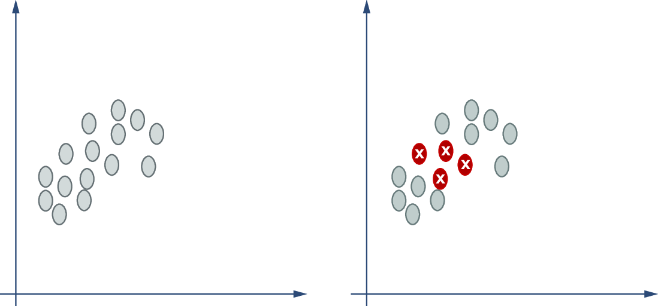
Use the figure to inspect how overlapping assignments and membership scores represent ambiguous cluster boundaries. section 5.5
