Life is a two-dimensional cellular automaton: a grid evolves in discrete steps, with each cell’s next state determined by the arrangement of its eight neighbors. Its appeal is both recreational and algorithmic, because simple local rules produce unexpectedly complex behavior. section 4.0 section 4.1
Apply the rules independently at every tick:
- A cell with three living neighbors is alive on the next tick. section 4.1
- A cell with two living neighbors stays the same; otherwise, it is dead. section 4.1
- Repeated application creates still lifes, oscillators, spaceships, guns, and patterns capable of simulating computation. section 4.1
From stillness to motion
A still life remains unchanged because every living cell has two or three neighbors and no dead cell has three. The blinker alternates between two states forever. The glider repeats its shape every four ticks while moving one square diagonally. section 4.1
Figure 4.3 The blinker is the simplest oscillator.
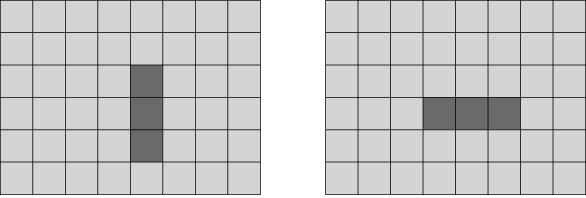
Use the blinker figure to inspect the simplest oscillating pattern and its two repeating states. section 4.1

