A game tree represents game states as nodes and legal moves as edges. Each player’s move creates branches of possible responses, forming a structure that can become extremely large. section 7.1
Chess search space
Chess typically offers about 30 legal moves per position and lasts roughly 40 move pairs. After three move pairs, more than 121 million board configurations may be possible. The Shannon number estimates the minimum number of possible chess games and illustrates why exhaustive enumeration is difficult. section 7.1
Traditional turn-based game programming, including IBM’s Deep Blue approach, stores the game tree in computer memory and evaluates the desirability of positions at branch endpoints. section 7.1
Figure 7.1 The starting position in chess (French Louvre collections of art) [1]
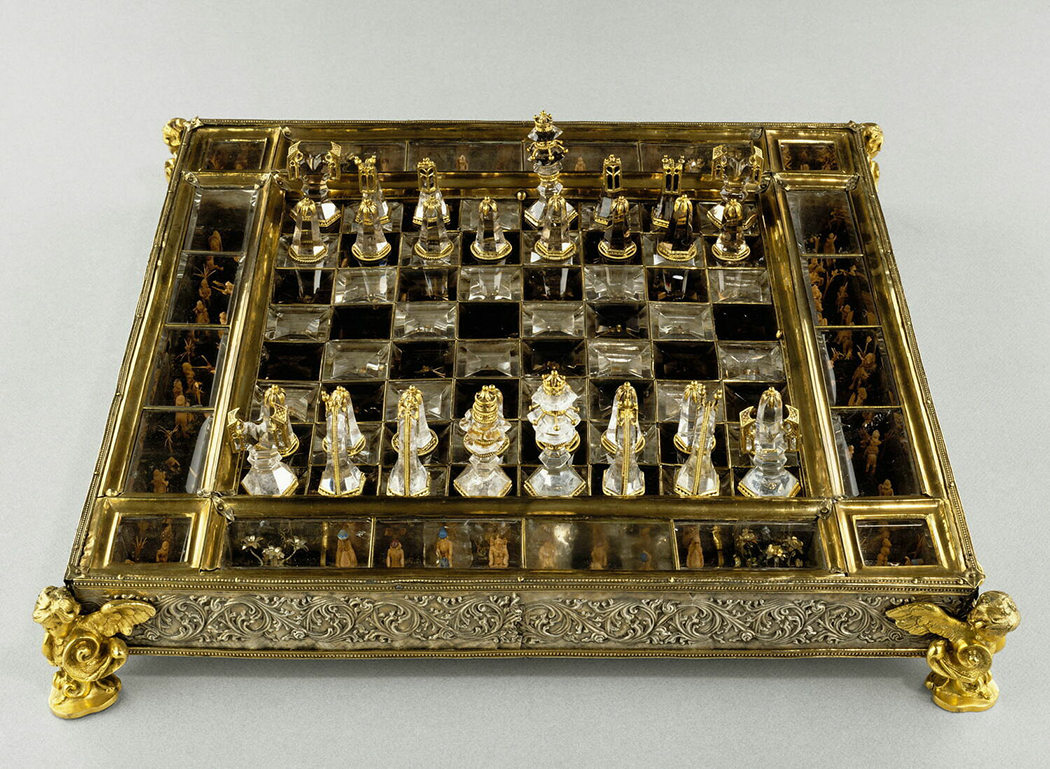
Use the chess starting position to ground the abstract tree in a familiar board state before considering its legal continuations. section 7.1

