Gating modulates information flow by multiplying a signal by a value between 0 and 1. A value of 0 blocks the signal, 1 passes it through, and intermediate values regulate its strength. section 6.6.2 section 6.8
An LSTM applies three gates to manage its long- and short-term states:
- Forget gate: controls which information leaves the context state Ct. section 6.6.2
- Input gate: controls what information enters Ct. section 6.6.2
- Output gate: controls how much of Ct contributes to the hidden state ht. section 6.6.2
A gated signal
Using the sigmoid activation, z = α · σ(·). When σ(·) is 0, z carries none of α; when it is 1, z carries all of α. Intermediate values partially transmit α. section 6.6.2
Figure 6.14 Diagram showing the detailed operations of an LSTM and how each gate is implemented and connected. The × indicates two values being multiplied together, and the + shows values being added together. The same color coding applies (red for the forget gate, blue for the input gate, and green for the output gate).
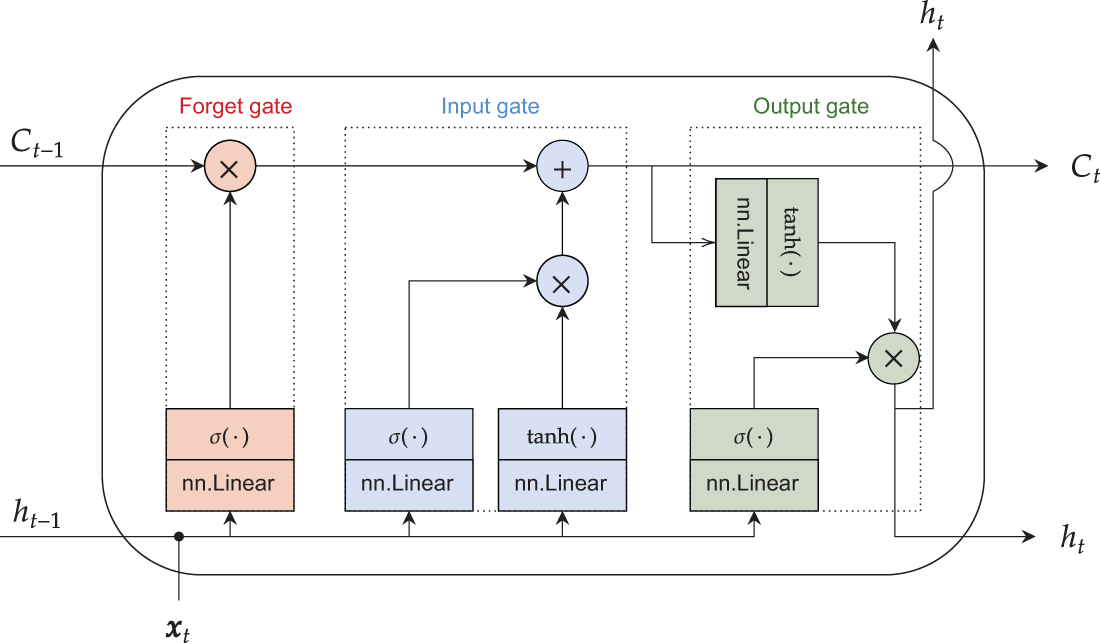
Use the detailed LSTM diagram to trace multiplication, addition, and the connections among the three gates, Ct, and ht. section 6.6.2



