A generalist model is built for broad capability across many tasks and domains. Its versatility makes it useful when outputs can be approximate, creative, or exploratory, but breadth carries an accuracy tax: a model optimized to be good at everything is not necessarily optimal for a specialized job. In finance, medicine, and legal review, domain-trained alternatives can outperform it because they encode focused patterns, context, and decision criteria. section 1.1.2 section 1.5.1
Use a generalist model as a starting point when requirements are low-stakes, accuracy demands are modest, and fast, low-complexity deployment matters. Creative-writing assistants, brainstorming tools, and casual customer engagement can benefit from varied responses without requiring a dedicated model. Organizations must still weigh provider dependency, privacy constraints, and the substantial compute needed for local deployment of frontier-scale models. section 1.1.2 section 1.5.1
Choose an approach by matching the task’s stakes, information needs, and precision requirements:
- Use prompt engineering for basic functionality where rough ideas or variable outputs are acceptable. section 1.5.1
- Pair a generalist model with retrieval-augmented generation (RAG) when current external knowledge is needed and some imprecision is tolerable. section 1.2.2 section 1.5.1
- Fine-tune a foundation model when a domain requires precise, consistent, structured outputs without relying on external data at response time. section 1.5.1 section 1.4
Figure 1.3 RAG process. It requires preprocessing the documents and storing them in a vector store, where chunks are paired with their vector representations and other metadata. The answering process is split into two phases: retrieval and generation. The first searches for chunks like the question; the second generates an answer by passing the retrieved documents to the LLM.
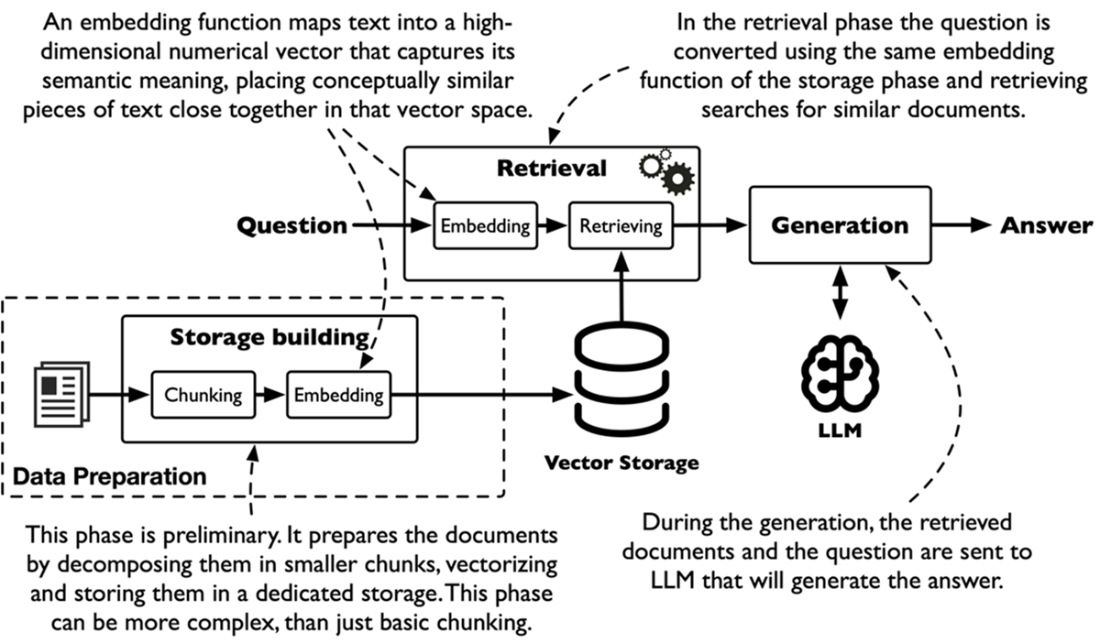
RAG augments a generalist model by retrieving relevant document chunks from a vector store, then supplying them as generation context. This improves information access, but retrieval alone does not supply the specialized reasoning needed to balance patient-specific factors or synthesize complex domain evidence. section 1.2.2
Customer-support ticket routing
A fine-tuned GPT-3.5 model trained with LoRA on 18 months of support data learned to separate routine billing questions from rare security breaches and outages. Compared with general-purpose methods, it improved ticket-classification F1 by more than 60%, reduced critical-ticket response time from 4.2 to 2.8 hours, and used far fewer trainable parameters than full fine-tuning. section 1.4.3
Credit-risk assessment
Given income, debt obligations, credit score, and late-payment history, a generalist model can produce a plausible debt-to-income calculation and narrative. Production lending workflows need more than plausible prose: they require organization-specific risk thresholds, compliance behavior, and structured operational outputs. Fine-tuning depends on consistent inputs paired with explainable decisions and rigorous evaluation. section 2.1 section 2.7
Fine-tuning turns a broad foundation into a specialized capability without training from scratch. Parameter-efficient methods such as LoRA keep base weights frozen while training small adapter modules, allowing one foundation model to support swappable domain adaptations. A practical cycle is to select a model with relevant domain exposure, clean and label data, train efficiently, and evaluate against predefined thresholds; dataset preparation and evaluation repeat as feedback loops. section 2.7 section 1.4

