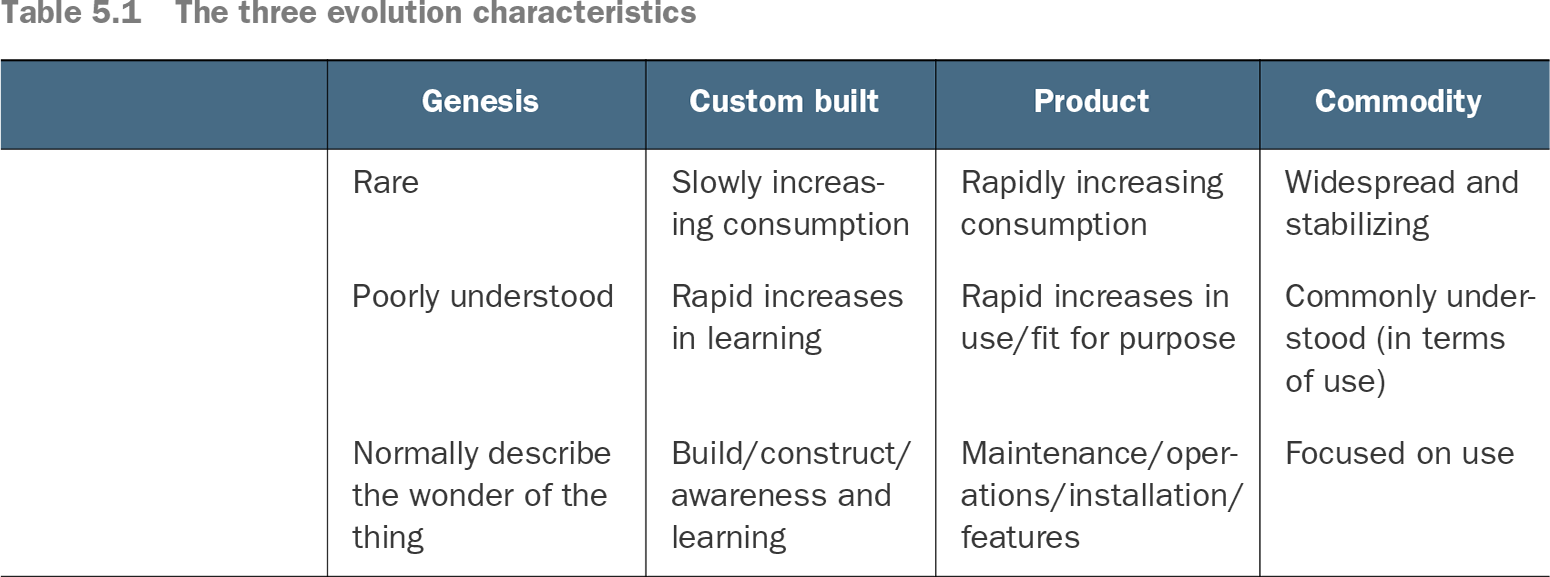
Genesis is the earliest stage of evolution on a Wardley Map. A genesis component is new, rare, and poorly understood: people are still exploring what it could do and how to use it. Its potential value may be high, but the path toward that value is uncertain and unpredictable. section 5.3.1 section 5.4.1 section 5.2
When placing a component on a map, ask:
- How many organizations have this capability? Rarity points toward genesis; widespread use points away from it. section 5.3.1
- How well does anyone understand its use? Early exploration points toward genesis; rapid learning may suggest it has moved into custom built. section 5.3.1
- Are people describing the wonder of the idea, or discussing how to build and use it? The language around a component offers another clue. section 5.3.1
An emerging delivery capability
Restaurant optimization—advice and recommendations to help restaurants grow—may sound novel. Yet a few organizations are already developing it, adoption is beginning, and teams are rapidly learning through new features. Those signals place it closer to custom built than genesis. Novelty alone is not enough to settle the classification. section 5.3.1
Treat a placement as a judgment to revisit, not a result produced by a precise flowchart. Industry knowledge and discussion matter because the signals can differ by component. Once mapped, a possible genesis component can prompt a strategic question: might it become a future differentiator, and is there enough demand for it to evolve? Components can move toward custom built, product, and commodity—or die along the way. section 5.3.1 section 5.4.1 section 5.6
Table 5.1 The three evolution characteristics (view table figure)
Compare ubiquity, certainty, and publication types across all four evolution stages before settling on a placement. section 5.3.1