Commodity is the mature stage of evolution on a Wardley Map. A commodity component is widespread, standardized, and commonly understood in use. Customers expect it, while competitors have similar versions. It is usually a cost of doing business rather than a source of differentiation; stability and efficiency matter more than novelty. section 5.2 section 5.4.1
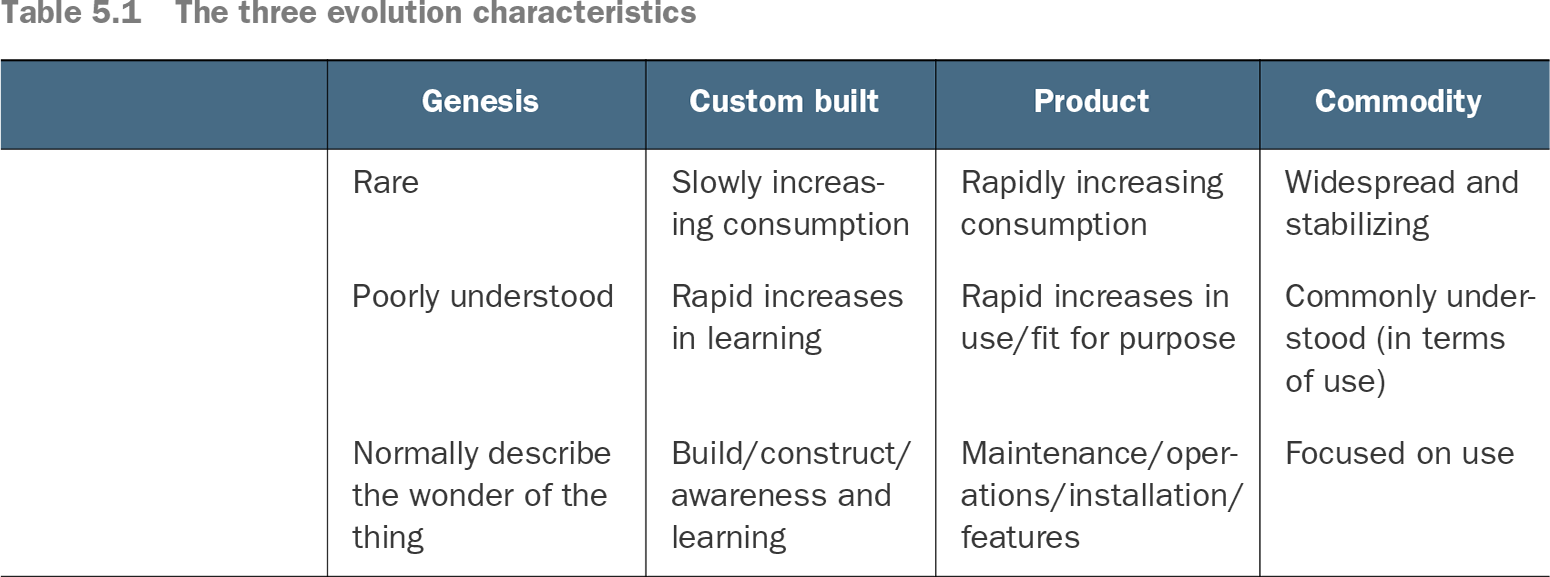
To assess a component, ask how widely it is used and how much remains to learn about using it. A widespread capability with familiar uses points toward commodity. An industry’s publications can offer another clue: at this stage, they focus on use rather than construction or emerging features. These are prompts for discussion, not a precise classification test; placement calls for industry knowledge and multiple perspectives. section 5.3.1
What commodity can look like
In online food delivery, menus are widespread and familiar, making them commodity-like. A cloud platform can also sit at the commodity stage when it resembles competitors’ platforms and is largely delegated to a provider. Neither example implies that every component in the same business belongs there: ordering may still offer some scope for differentiation. section 5.3.1 section 5.2
Table 5.1 The three evolution characteristics (view table figure)
Compare ubiquity, certainty, and publication types across all four evolution stages before deciding where a component belongs. section 5.3.1
Commodity status also changes investment decisions. If a capability is likely to become available off the shelf soon, major investment in a bespoke version may bring little lasting advantage. A company with an in-house CRM wanted to move to a cheaper-to-operate service, but tight coupling to bespoke capabilities made the move expensive. When mapping likely changes, ask both what may become a commodity and what architectural dependencies could make a later build-versus-buy decision costly. section 5.4.5
Losing differentiation in one component need not end innovation elsewhere. As components become widespread, they can enable new capabilities: commodity electricity supported new products, while evolving online payments helped more businesses operate online. Ask what becomes possible as a component matures, as well as what advantage it ceases to provide. section 5.4.2