A geometric module is a learned component that supplies continuous pattern recognition and informal intuition within a larger computational system. It complements algorithmic modules, which provide formal reasoning, search, memory, and abstraction. section 19.4.5 section 19.4.7
Geometric modules contribute by:
- Transforming input data through continuous operations rather than executing explicit symbolic procedures. section 19.4.7
- Recognizing patterns and supplying intuition that helps systems handle perception and similarity. section 19.5
- Working alongside algorithmic modules in models that combine learned intuition with reasoning, search, and memory. section 19.4.5
- Serving as reusable components that can be recombined across tasks instead of requiring one monolithic model for each problem. section 20.3
Hybrid intelligent systems
AlphaGo and self-driving cars illustrate early combinations of learned geometric capabilities with manually engineered or algorithmic components. A future learned program could combine geometric primitives for pattern recognition with algorithmic primitives for reasoning, search, and memory. section 19.4.5 section 19.4.7
Figure 19.15 A learned program relying on both geometric primitives (pattern recognition, intuition) and algorithmic primitives (reasoning, search, memory)
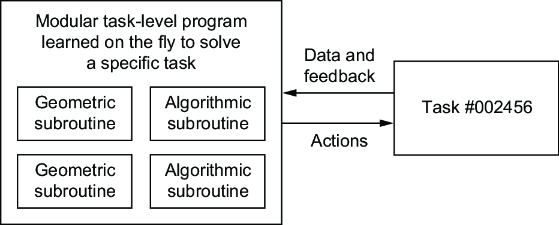
Use the figure to see how geometric primitives for pattern recognition and intuition combine with algorithmic primitives for reasoning, search, and memory. section 19.4.5
