getContext() returns a Canvas rendering context for a specified drawing mode. Calling canvasElement.getContext("2d") provides the 2D context used for drawing. section 15.3
Initialize the context when the canvas is ready:
- Bind the canvas node to canvasElement. section 15.3
- Call getContext("2d") inside onMount(), after the node enters the DOM. section 15.3
- Scale the context by window.devicePixelRatio when the canvas uses a resolution-corrected size. section 15.3
Canvas circles over SVG
A mixed-mode visualization places Canvas above an SVG container. After getContext("2d") initializes the drawing context, code sets fillStyle and strokeStyle, begins paths, draws arcs, and fills and strokes painting circles. section 15.3
Figure 15.11 Adopting the mixed-mode rendering approach, we use an SVG container to display the axes, drawings, and letters, and we add a canvas element on top that renders the painting circles.
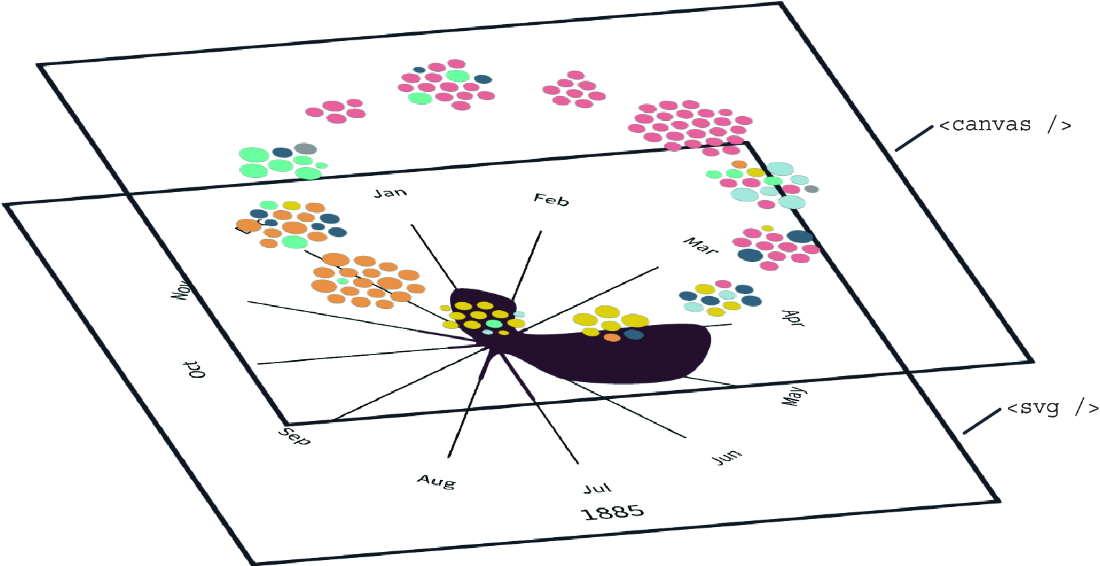
See how the Canvas layer complements SVG by rendering the painting circles. section 15.3
