liveBook · Manning

Gini impurity

As explained in Grokking AI Algorithms, Second Edition

The Gini index is an impurity measure that quantifies the likelihood of incorrect class assignment in a labeled dataset.

Gini impurity measures how mixed a labeled dataset is. A value of 0 means every example has the same class; larger values indicate greater uncertainty. Decision trees use it to judge whether a proposed question makes the data cleaner. section 8.17

A bag of diamonds

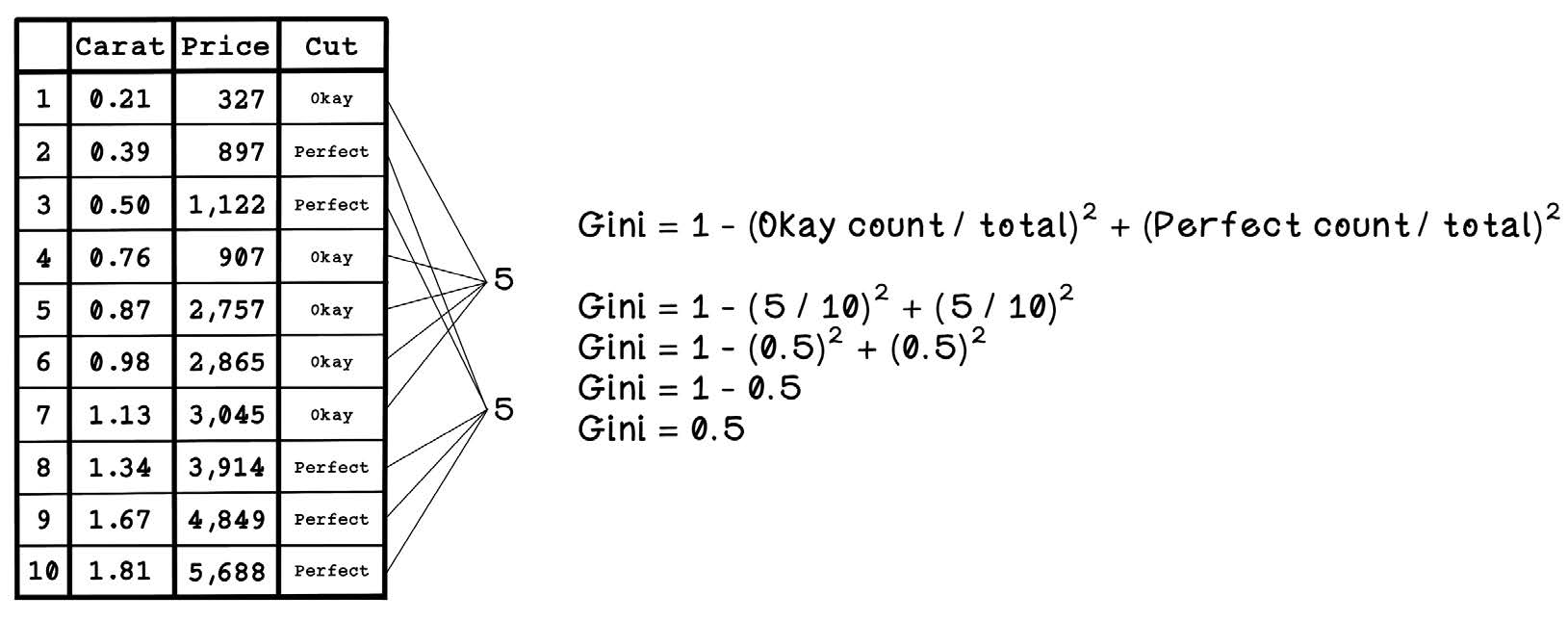
A bag containing five Perfect and five Okay diamonds is maximally mixed, with a Gini index of 0.5. A bag containing ten Perfect diamonds has a Gini index of 0. After testing feature questions, the tree compares the weighted impurity of the resulting groups with the original impurity; the reduction is information gain. section 8.17

Figure 8.21 The Gini index calculation
08_21

Use the calculation figure to connect class proportions with the impurity score. section 8.17

How Grokking AI Algorithms, Second Edition covers it

How deep it goes
Defines impurity, contrasts pure and mixed datasets, and implements the calculation without theoretical proof.
Examples
Uses Perfect and Okay diamonds, including balanced and completely pure bags, to illustrate impurity values.
What it assumes
Assumes labeled examples and basic feature-based classification, while introducing impurity and uncertainty through concrete examples.
What you can do after
Apply it via Python to calculate impurity and compare candidate decision-tree splits.
How it connects
Connects decision trees with entropy, information gain, classification labels, and feature-based data splits.

Also explained in

Compare how 5 books explain Gini impurity →

Related concepts

This explainer was generated by Manning's knowledge graph from the text of Grokking AI Algorithms, Second Edition. The section links point to the parts of the book it draws on.



