liveBook · Manning

Good page split

As explained in 100 SQL Server Mistakes and How to Avoid Them

A good page split is a page allocation event that adds a new page at the end of an index without moving existing data to preserve order.

A good page split occurs when SQL Server inserts into a full final index page, allocates a new page at the end, and preserves existing row order without moving data. section 9.2 section 11.1

Page splits are normal, not automatically harmful. The important distinction is location: splitting the last page avoids the out-of-order pages and avoidable I/O associated with a middle-of-index split. section 11.1

A full index reaches its final page

An index is full and SQL Server must add a row to its last page. It allocates the next page from the extent and inserts the row there; existing rows remain in place and order is preserved. section 9.2 section 11.1

Figure 9.1 Good page splits
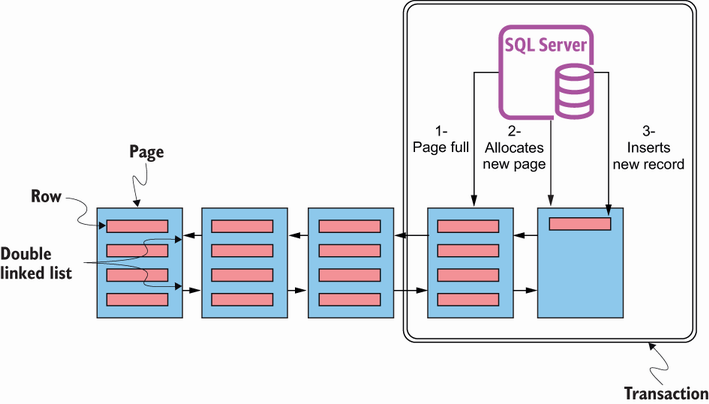
Use the figure to compare a good final-page allocation with a middle-of-index split. section 9.2

How 100 SQL Server Mistakes and How to Avoid Them covers it

How deep it goes
Explains allocation location, row movement, ordering, and I/O consequences, but stops short of detailed mitigation procedures.
Examples
Uses a full index receiving a final-page insert and contrasts it with a middle-of-index split.
What it assumes
Assumes basic knowledge of index pages and introduces page-split behavior through concrete insertion scenarios.
What you can do after
Evaluate page-split behavior by identifying final-page allocation and separating it from fragmentation-producing middle-page splits.
How it connects
Connects page splits to index fragmentation, external fragmentation, internal fragmentation, fill factor, and I/O.

Related concepts

This explainer was generated by Manning's knowledge graph from the text of 100 SQL Server Mistakes and How to Avoid Them. The section links point to the parts of the book it draws on.