A goroutine is Go’s lightweight unit of concurrent execution. Start one by placing go before a function call; the call runs separately, while the calling goroutine continues to its next instruction. This makes it practical to model many independent activities without directly allocating operating-system threads. section 1.5.1 section 2.3.1 section 2.3
Run independent work concurrently
A loop that calls doWork(i) normally completes one one-second task before starting the next, taking about five seconds for five tasks. Changing the call to go doWork(i) starts all five activities without waiting at each call, so their start and finish messages can appear in a different order and complete around the same time. The order is observable but not guaranteed by the creation loop. section 2.3.1
Compare the sequential call with the go-prefixed call. The sleep keeps main alive long enough for the child goroutines to finish, but it is only a temporary waiting technique. section 2.3.1
A goroutine is neither a process nor an operating-system thread. Current Go implementations group goroutine executions onto operating-system threads, with the runtime handling scheduling and context switching at the application level. The language specification does not strictly require one implementation strategy. section 2.3.2 section 2.3
Creating concurrent work does not by itself make a program correct. When main() runs out of instructions, it terminates the process, possibly before child goroutines run or finish. Concurrent goroutines may also share memory: one can update a countdown variable while another reads it, or many can update a shared letter-frequency slice. Such shared updates need careful coordination to avoid incorrect results and race conditions. section 2.3.1 section 3.2.1 section 3.2.3
Choose how goroutines cooperate based on the work and its data flow:
- Use channels when isolated goroutines should exchange messages or synchronize; this CSP-style approach reduces the risk of race conditions. section 1.5.2
- Use shared memory with classical primitives when that model better fits the problem or gives better performance. section 1.5.2
- Send a function result on a channel when background work must later return a value; receiving blocks until that result is available. section 7.1.5
Collect a background result
An anonymous goroutine can compute the factors of one large number and send its slice result on resultCh while main() computes factors for another. Reading <-resultCh retrieves the background result, waiting if necessary. This replaces an unsafe or awkward attempt to guess completion timing with a defined handoff point. section 7.1.5
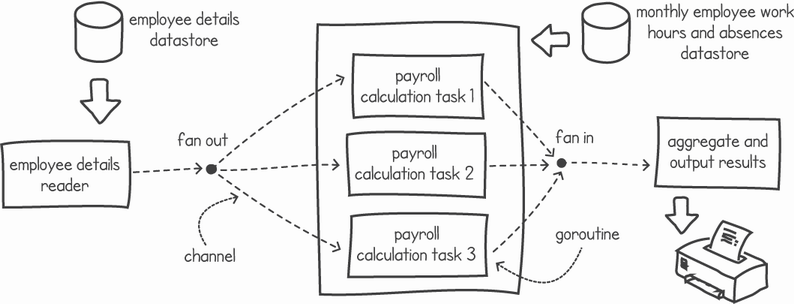
The diagram shows the CSP arrangement: isolated concurrent executions coordinate by sending messages through channels rather than directly sharing state. section 1.5.2
Goroutines help applications stay responsive, improve throughput during I/O waits, and can provide speedup on multiple processors. They do not remove limits imposed by serial work: performance still depends on the problem, available hardware, coordination costs, and the non-parallel portion of execution. section 1.7 section 1.0






