Logic control is the SCADA subsystem that evaluates and directs hardware operation: it sends commands, reads measurements, and calculates parameters. Autonomous logic uses operational data to continuously correct spacecraft orientation and movement. section 3.1.2
Treat logic control as a domain model rather than an all-purpose component. A dedicated embedded DSL can formally represent its rules, document the domain, and give engineers a place to express control logic through an external language, a custom DSL, or both. section 3.1.2
Keep the subsystem loosely coupled through an interoperability bus. Direct connections to hardware, databases, networks, GUIs, and simulators would enlarge logic control’s responsibilities; the bus abstracts interaction and allows implementations to vary. section 3.2.1 section 3.2.2
Develop the design progressively:
- Start with a requirements or necessity map identifying logic control, hardware protocols, simulators or spacecraft, databases, scripts, GUIs, hardware interfaces, and networks. section 3.1.2 section 3.2.1
- Expand logic control into an elements diagram, allowing domain terms, layers, libraries, and objects to be related without prematurely imposing architecture. section 3.2.2
- Separate control intelligence from communication responsibilities, then use the bus to connect the resulting modules. section 3.2.2 section 3.2.1
Spacecraft control
Control intelligence can correct spacecraft rotations or control life-support systems. The application’s logic evaluates measurements, calculates parameters, and issues commands while the interoperability layer mediates interaction with other components. section 3.1.2 section 3.2.2
Figure 3.3 Logic control mind map
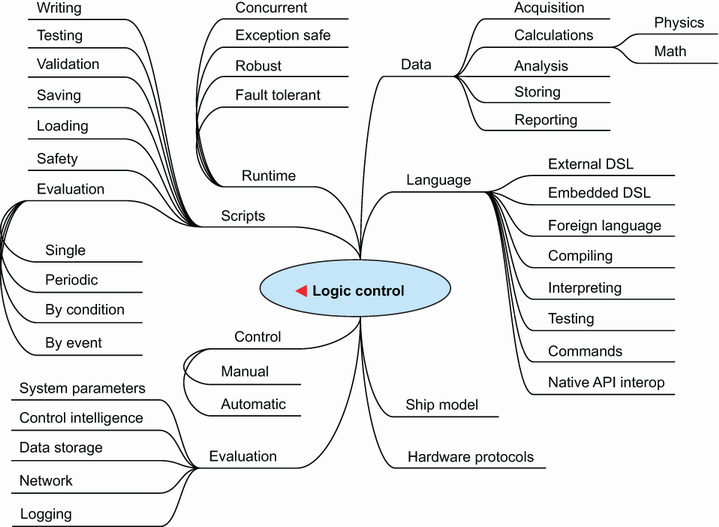
Use the logic-control mind map to inspect the subsystem’s requirements and its language, control, and integration concerns. section 3.1.2
