A chargeback investigation can miss coordinated activity when each transaction is examined alone. Graph-based pattern discovery instead views users, merchants, and their transactions as connected entities, making shared relationships easier to spot. section 7.4.1
Start with transaction records involving users who filed chargebacks. Map their connections to merchants, then inspect whether users share merchants or disputed transactions. A shared connection is a lead for investigation, not proof of fraud. section 7.4.1
Figure 7.5 A conceptual visualization of transactions involving users who filed chargebacks. This simplified graph highlights the ability to quickly identify commonly shared merchants among users. The numbers on the edges represent the transaction dates (YY.MM.DD format). The solid lines indicate normal transactions, while the dashed lines represent transactions that were later disputed as chargebacks. While this example remains intentionally minimal, such graph-based relationships become even more valuable in complex real-world scenarios where detecting shared connections can reveal fraud rings or coordinated behavior.
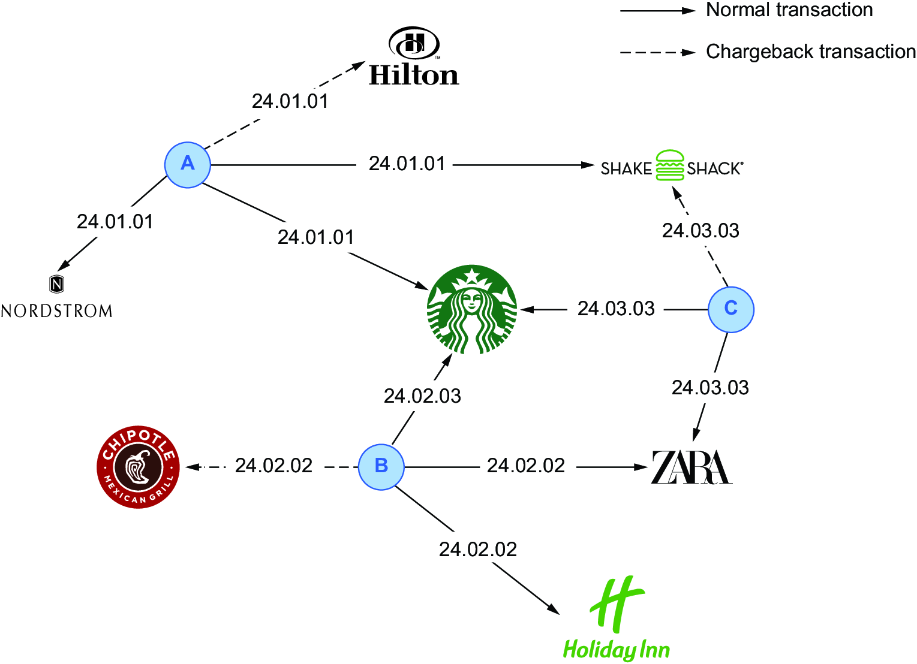
The conceptual graph distinguishes ordinary transactions from later-disputed ones and labels transaction dates, making shared merchants visible. section 7.4.1
