Graph neural network
A graph neural network is a neural-network model that learns representations or predictions from graph-structured data by combining information from connected entities.
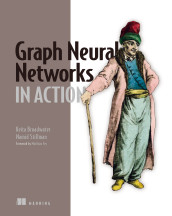
Graph Neural Networks in Action
A graph neural network architecture specifies the layers, computations, and connectivity used by a graph neural network.
- How it is used
- Models relationship-centric data for node, edge, or graph predictions when connections contribute useful information.
- How deep it goes
- Builds from graph representation to message-passing layers and a coded two-layer GCN; defers detailed convolution treatment.
- Examples
- Uses a two-layer GCN embedding model, sparse user-item interactions, and atom-bond graphs for molecular prediction.
- What you can do after
- Build it from scratch as a basic two-layer GCN in PyTorch Geometric and evaluate whether graph relationships justify its use.
Read how Graph Neural Networks in Action explains graph neural network →

Build AI Drug Discovery Pipelines
A graph neural network is a neural-network model that computes representations or predictions from graph-structured data by propagating information among connected nodes.
- How it is used
- Uses graph representations to predict drug–target binding affinity and prioritize candidates for experimental testing.
- How deep it goes
- Explains message-passing steps, graph tensors, and a dual-stream architecture, while deferring full derivations and worked GNN examples.
- Examples
- Uses benzene ring connectivity and a dual-graph drug–protein predictor to illustrate graph-based learning.
- What you can do after
- Build from scratch a dual-stream drug–target affinity predictor using PyTorch Geometric.
Read how Build AI Drug Discovery Pipelines explains graph neural network →

Financial AI in Practice
A neural network that learns from graph-structured data by aggregating information across connected nodes.
- How it is used
- Uses GNNs to detect relational fraud patterns and identify higher-order signals for financial recommendations.
- How deep it goes
- Explains neighborhood aggregation and walks through a simplified two-layer model, while distinguishing it from production-scale GNNs.
- Examples
- Uses transactions linked by shared users or devices and a shared-holdings recommendation scenario.
- What you can do after
- Builds a simplified fraud-classification GNN from scratch with PyTorch, not a production-ready detection system.
Read how Financial AI in Practice explains graph neural network →

Knowledge Graphs and LLMs in Action
A graph neural network is a neural network architecture that learns representations by propagating information among nodes and edges of a graph.
- How it is used
- Deploys graph structure and node attributes to learn representations for classification, link prediction, and other graph-based machine-learning tasks.
- How deep it goes
- Explains message passing, trainable update rules, embeddings, and encoder–decoder workflows, without deriving advanced architectures.
- Examples
- Uses financial transaction graphs for AML classification and user–movie interaction graphs for recommendation link prediction.
- What you can do after
- Apply it via PyTorch Geometric to build and evaluate node-classification or link-prediction systems.
Read how Knowledge Graphs and LLMs in Action explains graph neural network →

Fight Fraud with Machine Learning
A graph neural network is a neural-network model that learns patterns from graph-structured data by combining node features with graph connectivity.
- How it is used
- Detects fraud patterns in connected social accounts and transaction networks by using graph relationships.
- How deep it goes
- Defines GNN neighbor aggregation and contrasts GCN and GAT, while deferring detailed implementation internals.
- Examples
- Uses social-network node classification and labeled Bitcoin transaction graphs for bot and money-laundering detection.
- What you can do after
- Evaluate/understand when graph relationships can improve illicit-transaction detection beyond an MLP baseline.
Read how Fight Fraud with Machine Learning explains graph neural network →

Optimization Algorithms: AI techniques for design, planning, and control problems
A graph neural network is a neural network architecture that learns representations and predictions from graph-structured data.
- How it is used
- Applies graph representations and predictions to combinatorial optimization problems such as TSP, VRP, SAT, MaxCut, and MIS.
- How deep it goes
- Explains encoding, message passing, prediction, search, and learning objectives, while deferring training implementation details to substantial code and preprocessing.
- Examples
- Uses TSP, pretrained models, node and edge probabilities, Concorde solutions, beam search, and a Gurobi-assisted implementation.
- What you can do after
- Apply it via pretrained models to predict and search feasible TSP solutions.
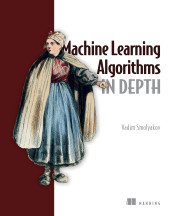
Machine Learning Algorithms in Depth
A graph neural network is a neural-network architecture that computes representations by propagating information over graph-structured data.
- How it is used
- Uses graph-structured relationships and node features to classify documents in a citation network.
- How deep it goes
- Defines adjacency and feature matrices, distinguishes classification targets, and provides a GCN implementation listing.
- Examples
- Uses CORA documents, citation edges, word-indicator features, and a t-SNE view of a hidden representation.
- What you can do after
- Apply it via Spektral’s GCNConv with TensorFlow/Keras to classify nodes in a citation graph.
Read how Machine Learning Algorithms in Depth explains graph neural network →

Retrieval Augmented Generation, The Foundational Ideas
A graph neural network is a neural network that learns representations from graph-structured data by aggregating information across connected nodes.
- How it is used
- Uses graph-based passage refinement before FiD fusion to remove distracting evidence and reduce decoder workload.
- How deep it goes
- Defines neighbor aggregation and gives a three-stage pipeline, but stops short of layer details, training procedures, or message-passing equations.
- Examples
- Demonstrates KG-FiD with passage nodes, entity-sharing edges, and a curated subset passed to FiD.
- What you can do after
- Apply it via KG-FiD to pre-filter noisy passages before encoder-decoder fusion.
Read how Retrieval Augmented Generation, The Foundational Ideas explains graph neural network →
Also covered in
What to know first
- language modelA language model is a computational model that represents patterns in linguistic sequences to assign probabilities, predict, generate, or evaluate language.
- graphA graph is a mathematical structure consisting of vertices and edges that connect pairs of vertices to represent relationships or connections.
- accuracyAccuracy is the degree to which a result agrees with a specified truth, reference, or criterion, commonly measured as the proportion of evaluated predictions that are correct.
- convolutional neural networkA convolutional neural network is a neural-network architecture that processes structured inputs with convolutional operations, typically using learned local filters to capture patterns.
Related concepts
- graph attention networkincludes · A graph attention network is a graph neural network that uses attention weights to aggregate information from neighboring nodes, allowing their contributions to differ.
- graphuses · A graph is a mathematical structure consisting of vertices and edges that connect pairs of vertices to represent relationships or connections.
- PyTorch Geometricused by · PyTorch Geometric is an open-source Python library that extends PyTorch with data structures and operators for graph and geometric machine learning.
- node classificationuses · Node classification is a graph-learning task that predicts one or more discrete category labels for individual nodes in a graph.
- link predictionuses · Link prediction is a graph-learning task that estimates whether a connection exists or may occur between nodes, often by scoring candidate links.
- dynamic graph neural networkincludes · A dynamic graph neural network is a graph neural network that models graph structures and node or edge information as they change over time.
Questions about graph neural network
What is graph neural network?
A graph neural network is a neural-network model that learns representations or predictions from graph-structured data by combining information from connected entities.
Which Manning books explain graph neural network?
Graph Neural Networks in Action, Build AI Drug Discovery Pipelines, Financial AI in Practice, Knowledge Graphs and LLMs in Action, Fight Fraud with Machine Learning, Optimization Algorithms: AI techniques for design, planning, and control problems, Machine Learning Algorithms in Depth and Retrieval Augmented Generation, The Foundational Ideas.
What should I know before learning graph neural network?
Manning books that teach graph neural network usually introduce language model, graph, accuracy and convolutional neural network first.
What kinds of graph neural network are there?
Kinds of graph neural network include graph attention network and dynamic graph neural network.
What is graph neural network also called?
Graph neural network is also called GNN.
These guides are generated from the text of Manning books by Manning's knowledge graph and link to the sections they draw on. The full books are available on liveBook and at manning.com.