A graph neural network (GNN) learns node, edge, or graph representations by repeatedly aggregating information from neighboring nodes and transforming it with trainable parameters. Unlike fixed-size neural-network inputs, message passing handles varying numbers of neighbors while capturing structural patterns and node properties. section 11.0 section 11.5 section 11.5.3
A practical GNN workflow follows an encoder–decoder pipeline:
- Represent domain objects as nodes and their interactions as edges, producing a graph from semistructured data. section 12.0
- Encode each node by aggregating representations from its neighbors, applying trainable self and neighborhood transformations, and repeating the process across layers. section 11.5 section 11.5.3
- Decode the learned embeddings for a downstream task such as node classification or link prediction, using a task-specific objective. section 12.0 section 12.3
- Evaluate predictions with task-appropriate measures, including precision, recall, F1-score, confusion matrices, or metric-trend visualizations. section 12.0 section 12.1
Two applied patterns
For anti-money-laundering analysis, model accounts or entities as nodes and transactions as edges; a homogeneous GNN learns embeddings and classifies nodes as licit or illicit. For recommendations, represent users and movies in a heterogeneous graph; a heterogeneous GNN learns embeddings and predicts user–movie links. section 12.1 section 12.2
Figure 12.1 End-to-end framework to develop a GNN-based system that can be adopted for multiple tasks and application domains. The input data is usually a collection of semistructured sources describing different objects and interactions between them. The goal is to process the data and produce a graph that becomes the input for an encoder–decoder architecture. In our scenarios, the encoder uses a GNN model, and the decoder is based on a function that allows us to optimize the model for a specific downstream task. The output of this framework is a trained model that can be adopted for the inference phase.
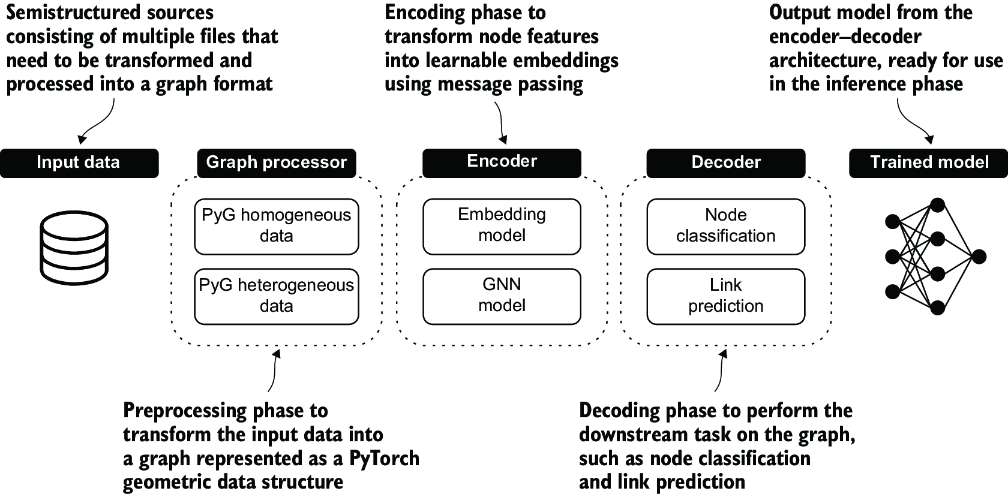
Use the end-to-end framework to trace graph construction, GNN encoding, task-specific decoding, optimization, and inference. section 12.0







