A dynamic graph neural network models relational data as it changes over time. It connects sequential graph snapshots so recent observations can support predictions about unseen future events. section 6.0 section 6.3
Use a dynamic GNN when both relationships and their associated information evolve:
- Model changing friendships, road conditions, traffic patterns, or arrival-time predictions. section 6.1
- Predict trajectories of interacting bodies, including molecules, cells, objects, or stars. section 6.1
- Represent temporal data by combining graph snapshots and adding temporal edges between corresponding nodes. section 6.3
Pose estimation
Treat a walking body as a relational graph observed across video frames. A model learns from earlier poses and predicts the next step, either with a temporal graph and masked nodes or with snapshot encoders followed by VAEs and RNNs. section 6.0 section 6.3
Figure 6.1 Examples of different dynamic problems
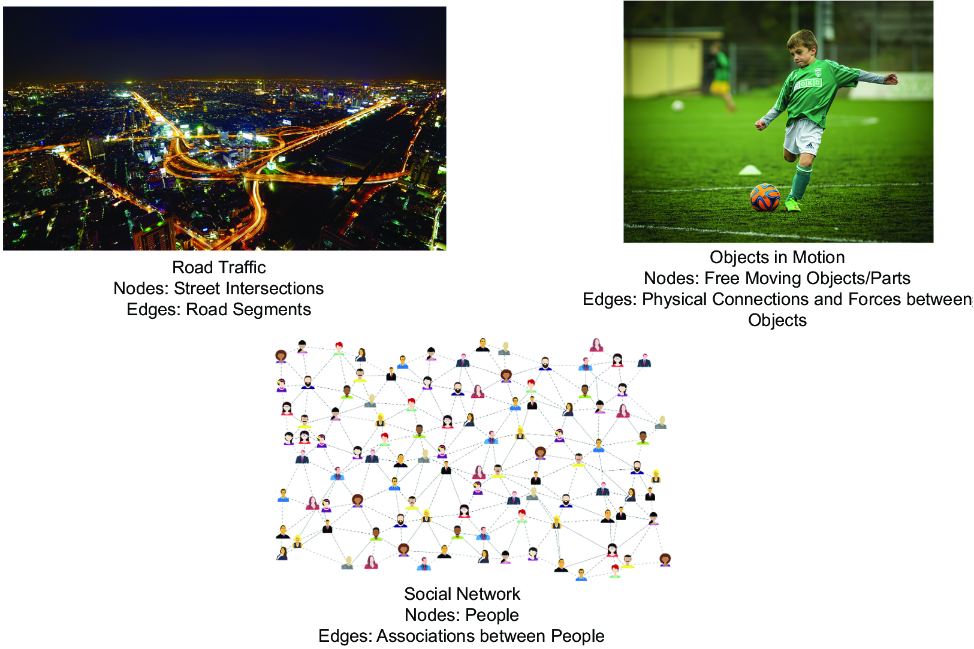
Compare dynamic problems involving social relationships, traffic, and interacting trajectories. section 6.1
