A graph clustering method partitions interconnected nodes into communities using topology, relationships, direction, or edge weights rather than independent vector features. It supports community detection, graph summarization, and analysis of large networks. section 9.2.3 section 9.3.3
Common approaches differ in how they define a group:
- Weakly connected components group nodes solely by connectivity. section 9.3.3
- Louvain optimizes modularity, favoring communities denser than expected in a random network and revealing hierarchical structure. section 4.2.2
- Label propagation spreads labels through the network, but randomness can produce different results across runs. section 9.3.3
Protein-interaction network
On a 21,559-protein network, WCC produced 27 components dominated by one giant component. Louvain instead produced 48 communities, with an overall modularity of about 0.55 and an average community size of about 449 proteins. section 4.2.2
Figure 9.4 Flow of community detection. The input is a graph, and the output is a mapping between nodes and groups (circled in the image).
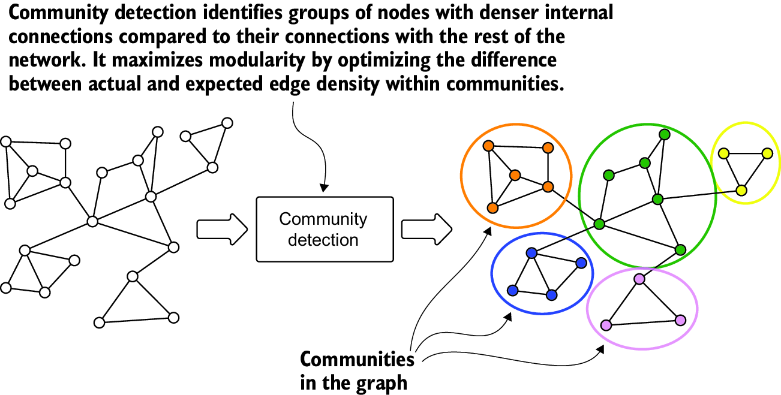
Use the flow diagram to trace graph input into a node-to-community mapping. section 9.2.3
