A graph database system stores and processes graph data: nodes represent entities, and edges represent relationships. These systems support graph-specific query languages and are optimized for processing large graphs. section 5.4.1
For natural-language analysis, a language model can translate a question into a formal graph query, such as Cypher, using information about the graph structure. A specialized system processes the query and returns results; check generated queries rather than trusting them blindly. section 5.1 section 5.5
Subway connections
A subway network can represent stations as nodes and direct connections as edges labeled with the subway line. Node properties can store station names. section 5.4.1
Figure 5.2 An example graph representing a small part of the subway network in New York City. Nodes, drawn as circles, represent subway stations and are associated with a property, assigning them to the name of the represented subway station. Edges, drawn as arrows, represent direct connections via specific subway lines. Edges are labeled by the subway line connecting the stations.
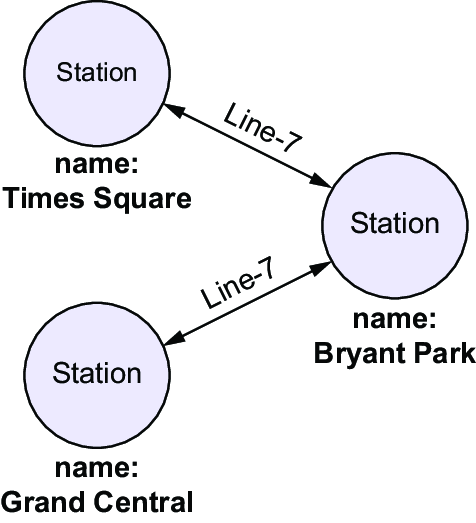
See how stations, line-labeled connections, and station-name properties are represented in a subway graph. section 5.4.1



